THE HERO HISTORY ALMOST FORGOT: CHARLES YOUNG
THE HERO HISTORY ALMOST FORGOT: CHARLES YOUNG
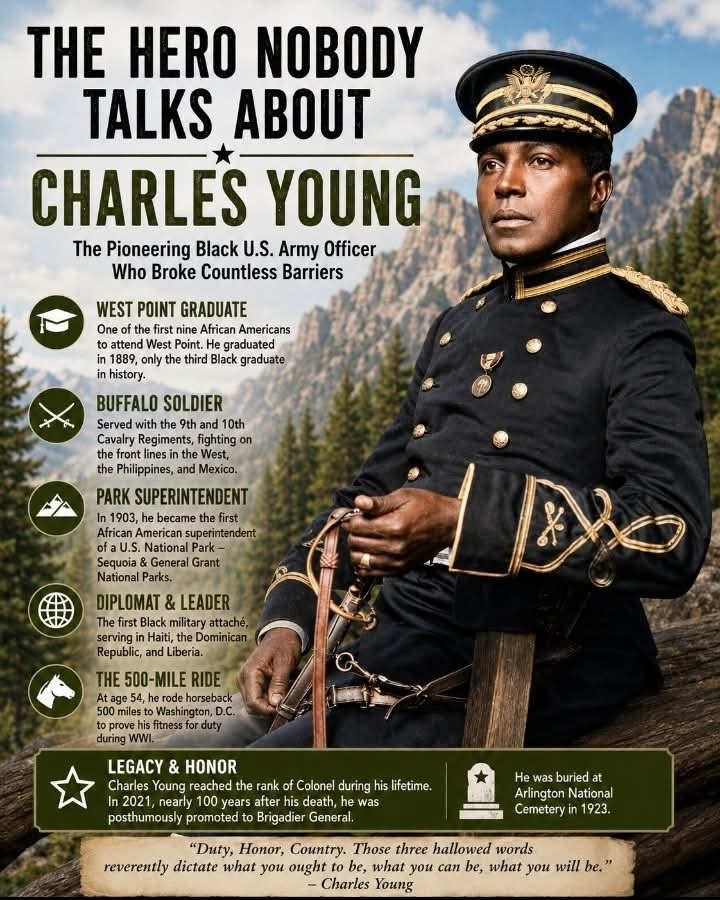
Imagine being born to enslaved parents in Kentucky in 1864—and eventually becoming one of the highest-ranking Black officers in the U.S. Army.
Now imagine having to prove your ability again and again, not because you lacked talent, but because of the color of your skin.
That was the life of Charles Young.
Young was born in May’s Lick, Kentucky, during the American Civil War. His father, Gabriel Young, escaped slavery and later served in the Union Army. Charles grew up in an environment that emphasized education, discipline and self-improvement.
🎓 HE BROKE INTO WEST POINT
In 1884, Young entered the United States Military Academy at West Point.
He was only the ninth African American to attend West Point and, when he graduated in 1889, became just the third Black graduate in the academy’s history.
But getting through West Point was not simply an academic achievement.
Young endured racial hostility and isolation while studying at an institution where very few Black cadets had ever been admitted.
After graduation, he was commissioned as a second lieutenant.
Yet even then, discrimination followed him.
The Army delayed his first assignment partly because white military leaders were unwilling to have a Black officer command white soldiers. Young eventually served with the 9th Cavalry, one of the famous Black Buffalo Soldier regiments.
🐎 HE BECAME A BUFFALO SOLDIER
Young served in the segregated 9th and 10th Cavalry and participated in American military campaigns in places including the western United States, the Philippines, Haiti and Mexico.
He wasn’t simply a field officer.
He was an educator, administrator, diplomat and military leader.
At Wilberforce University, he taught military science and tactics and helped prepare young Black students for military service and leadership.
Among those he mentored was Benjamin O. Davis Sr., who later became the first Black general officer in the U.S. Army.
🌲 THEN HE BROKE ANOTHER BARRIER
In 1903, Young became the first African American superintendent of a U.S. national park.
He was placed in charge of Sequoia and General Grant National Parks in California.
Under his leadership, troops worked on roads and trails and helped improve access to the parks. His appointment demonstrated that his abilities extended far beyond the battlefield.
🌍 HE ALSO BECAME A DIPLOMAT
Young later served as a military attaché.
In 1904, he became the first African American military attaché, serving in Haiti and the Dominican Republic. He was later assigned to Liberia.
Think about that for a moment.
A Black American born during slavery had risen high enough to represent the United States overseas.
🐎 THE 500-MILE RIDE
Perhaps the most remarkable episode of Young’s career came during World War I.
In 1917, Young was medically retired and promoted to colonel in recognition of his distinguished service. He challenged the decision and wanted to demonstrate that he was physically capable of active duty.
At age 54, he undertook an extraordinary roughly 500-mile horseback journey from Wilberforce, Ohio, to Washington, D.C.
It was a powerful demonstration of determination and fitness.
But the Army did not reverse his retirement decision.
Young nevertheless returned to service in other capacities, helping train Black troops during World War I.
🇱🇷 HIS FINAL MISSION
In 1920, Young was sent to Liberia as a military attaché.
While visiting Nigeria in late 1921, he became seriously ill.
Charles Young died in Lagos on January 8, 1922, at the age of 57.
Because of the circumstances surrounding his death and British colonial regulations, his remains remained in Lagos for about a year before being returned to the United States.
When his body arrived in New York in 1923, thousands of people came out to honor him.
On June 1, 1923, Young received a funeral service at Arlington Memorial Amphitheater and was buried at Arlington National Cemetery.
⭐ THE RECOGNITION CAME DECADES LATER
During his lifetime, Young never became a general.
But history eventually acknowledged how significant his career had been.
On November 1, 2021, nearly a century after his death, Charles Young was posthumously promoted to Brigadier General.
His story is bigger than military rank.
Charles Young represents what can happen when education, discipline, perseverance and leadership confront enormous institutional barriers.
He was born into slavery.
He graduated from West Point.
He became a Buffalo Soldier.
He educated future leaders.
He became America’s first Black national park superintendent.
He became its first Black military attaché.
He reached the rank of colonel.
And even after death, his legacy continued to receive recognition.
Charles Young did not simply break one barrier. He spent his entire career breaking one after another.
And perhaps that is why his story deserves to be remembered.
If you had never heard of Charles Young before today, share this post. Someone else deserves to know his name too.