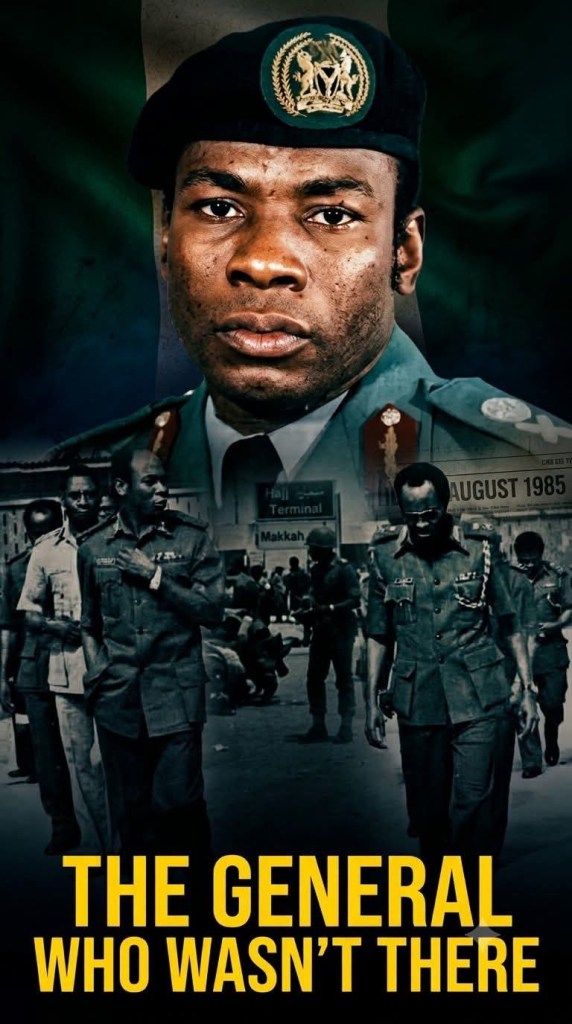
THE GENERAL WHO WAS OUT OF NIGERIA WHEN HIS GOVERNMENT WAS TOPPLED
THE GENERAL WHO WAS OUT OF NIGERIA WHEN HIS GOVERNMENT WAS TOPPLED
For almost two years…
Nigeria had a man who seemed almost impossible to challenge.
His name was Major General Tunde Idiagbon.
He wasn’t Nigeria’s Head of State.
But inside the Buhari government…
He was arguably the most powerful man after Buhari himself.
And then, in August 1985…
He left the country.
That absence would change everything.
Idiagbon was born in Ilorin on 14 September 1943.
He entered the Nigerian Military School as a teenager and eventually became one of the most prominent officers of his generation.
He fought in the Nigerian Civil War.
He served as Borno’s military administrator.
He became Military Secretary of the Nigerian Army.
Then came 31 December 1983.
The Second Republic collapsed.
The military overthrew President Shehu Shagari.
Muhammadu Buhari became Head of State.
And Idiagbon became Chief of Staff, Supreme Headquarters.
Officially, he was number two.
In practice…
He became the face of the government.
Then came the policy that made his name famous across Nigeria.
The War Against Indiscipline.
People were ordered into queues.
Late workers were punished.
Public officials were targeted.
Nigerians were lectured about discipline, punctuality and national responsibility.
Idiagbon personally announced many of the government’s toughest measures.
To some Nigerians…
He represented the return of order.
To others…
He represented the frightening face of military authoritarianism.
Either way…
Everybody knew his name.
But inside the military…
Something else was happening.
The Chief of Army Staff was Ibrahim Babangida.
And relations between the powerful men at the top were becoming increasingly complicated.
By 1985, the Buhari-Idiagbon government had been in power for about 20 months.
Then came the opportunity.
Idiagbon travelled to Saudi Arabia for pilgrimage.
Buhari was also away from Lagos.
And suddenly…
The two men at the top of Nigeria’s military government were outside the capital.
That was when Babangida and his allies moved.
27 August 1985.
The coup began.
Radio announcements followed.
Buhari’s government had been overthrown.
Babangida was now in control.
And Idiagbon?
He was thousands of kilometres away in Saudi Arabia.
He returned to a government that no longer existed.
He was removed from office.
Then placed under house arrest.
For roughly three years, the man who had once helped run Nigeria’s daily affairs was effectively shut away from public power.
There is an intriguing question surrounding his absence.
Some later Nigerian accounts have argued that the Saudi pilgrimage was more than coincidence — that Idiagbon’s trip was deliberately encouraged or exploited to remove the biggest obstacle to the coup.
One Nigerian retrospective even describes the invitation as a possible decoy.
But that part remains disputed.
What is not disputed is the remarkable timing:
Idiagbon was abroad.
Buhari was away.
And Babangida struck.
After his release…
Idiagbon returned to Ilorin.
He largely disappeared from national politics.
The transformation was almost unbelievable.
The man who had once stood before the entire country announcing new rules…
Was now living quietly outside the machinery of government.
No new coup.
No return to power.
No second political life.
Just silence.
Then, on 24 March 1999…
Tunde Idiagbon died in Ilorin.
He was only 55 years old.
Less than two months later…
Nigeria returned to civilian democratic rule under President Olusegun Obasanjo.
The man who had once represented one of Nigeria’s toughest periods of military rule therefore died just as the country was preparing to close that chapter.
And that is what makes his story so striking.
He didn’t lose power because someone defeated him in battle.
He didn’t face a firing squad.
He didn’t resign.
He was simply outside the country when the men who wanted his government gone made their move.
A pilgrimage.
A palace coup.
And a government that disappeared while its strongest enforcer was thousands of miles away.
Tunde Idiagbon never became Head of State.
But for almost two years…
he was one of the most powerful men in Nigeria.
And when the moment came…
being number two wasn’t enough.
If Idiagbon had been in Nigeria on 27 August 1985, do you think Babangida’s coup would still have succeeded?