THE SULTAN WHO REFUSED TO BOW: HOW BRITAIN TOOK NORTHERN NIGERIA
THE SULTAN WHO REFUSED TO BOW: HOW BRITAIN TOOK NORTHERN NIGERIA
Imagine waking up one morning and discovering that the political system your ancestors built over generations was no longer yours to control.
No election.
No referendum.
No agreement from the people.
Just a foreign army marching toward your capital.
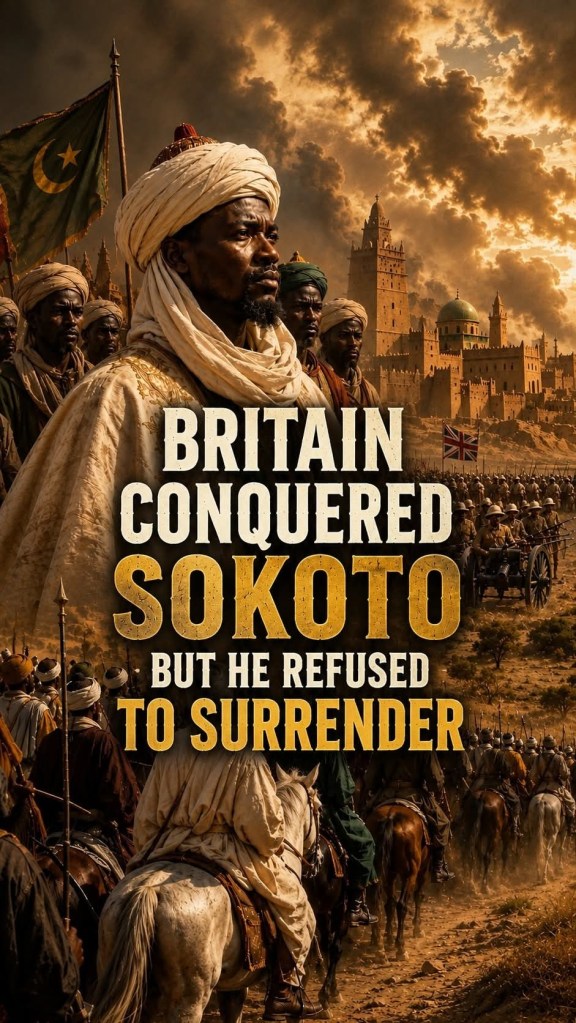
That was the reality facing Sultan Muhammadu Attahiru I of Sokoto in 1903.
But to understand his story, we have to go back.
Long before Nigeria became a country, the northern part of the region was home to one of the most powerful political systems in West Africa—the Sokoto Caliphate.
Founded during the jihad of Usman dan Fodio in the early 19th century, the caliphate grew into a vast network of emirates stretching across much of what is now northern Nigeria and neighboring regions.
Sokoto was not an insignificant settlement.
It was the political and religious heart of a powerful state.
Then Europe entered the race for Africa.
Britain wanted control of the Niger region.
France was expanding across West Africa.
Germany was also pursuing territory.
And Britain increasingly saw the northern territories as strategically and economically important.
Enter Frederick Lugard.
In 1900, Lugard became High Commissioner of the Protectorate of Northern Nigeria.
But there was a problem.
Britain could claim territory on paper, but the Sokoto Caliphate already governed the land.
So Britain began turning its claims into reality.
Diplomacy came first.
Then pressure.
And eventually, military force.
The British possessed something that gave them a devastating advantage: modern weapons, artillery, disciplined infantry and machine guns.
The armies of the northern emirates could be courageous and experienced, but they were not equipped for a war against a modern colonial military force.
Then came the turning point.
Kano fell in February 1903.
And once Kano fell, the message was clear:
If one of the most powerful emirates could be defeated, Sokoto itself was no longer safe.
Then the British marched toward the capital.
Sokoto fell in March 1903.
But here is where the story becomes extraordinary.
The Sultan, Muhammadu Attahiru I, refused to simply become a ruler under British authority.
He left Sokoto.
He and his followers began moving eastward in what became associated with a Hijra, a migration away from territory controlled by a power they refused to recognize.
Britain installed another Sultan, Muhammadu Attahiru II, effectively bringing the institution of the Sultanate under colonial supervision.
But Attahiru I was still out there.
And as long as he remained alive and continued to command followers, Britain had a problem.
There were now two competing ideas of legitimacy:
A Sultan in Sokoto recognized by the British…
And Attahiru I, who had refused to surrender.
The British pursued him.
The journey eventually led to Burmi.
And on 27 July 1903, the final confrontation came.
Attahiru I and many of his followers were killed.
The independent political power of the Sokoto Caliphate was effectively broken.
But here’s the part many people don’t realize.
Britain did not completely destroy the traditional emirate system.
Instead, it used it.
The British developed what became known as Indirect Rule.
Emirs could remain.
Traditional institutions could remain.
Local administration could remain.
But sovereignty had changed hands.
The emir could govern—but ultimately under British authority.
And this was one of the cleverest aspects of British colonialism.
They didn’t always need to replace African rulers.
Sometimes, they simply placed those rulers underneath a colonial government.
The palace remained.
The title remained.
The traditional authority remained.
But the final decision belonged to Britain.
And eventually, in 1914, Britain amalgamated Northern and Southern Nigeria into one colony.
So when we talk about the creation of Nigeria, we shouldn’t imagine that the country simply appeared on a map.
There were powerful African states here before colonial Nigeria existed.
There were kingdoms.
There were caliphates.
There were emirates.
There were political systems.
And there were rulers who resisted losing their sovereignty.
Sultan Muhammadu Attahiru I became one of the most powerful symbols of that resistance.
He lost his capital.
He lost his state.
And ultimately, he lost his life.
But he refused to accept the idea that his people should simply become subjects of a foreign empire.
And that leaves us with a difficult question:
Was Attahiru I simply a defeated ruler—or should history remember him as a symbol of resistance against colonial conquest?
And another question for debate:
Did Britain actually destroy the traditional political systems of Northern Nigeria, or did it cleverly take control of those systems and use them to govern the people?
I want to hear your thoughts.
If you were Sultan Muhammadu Attahiru I in 1903, would you have fought, negotiated, or accepted British rule to protect your people from further bloodshed?
👇 Let’s debate respectfully in the comments.