THE AFRICAN CIVILIZATION THAT TRADED WITH THE ANCIENT WORLD
THE AFRICAN CIVILIZATION THAT TRADED WITH THE ANCIENT WORLD
Let me ask you something…
When you hear about ancient international trade, which civilizations immediately come to mind?
Rome?
Greece?
Persia?
India?
But what if I told you there was a powerful African kingdom sitting right in the middle of one of the ancient world’s busiest trade networks?
Its name was Aksum.
Long before modern globalization, Aksum was already connected to Africa, Arabia, the Mediterranean and the Indian Ocean.
And this wasn’t just a small kingdom exchanging goods with its neighbors.
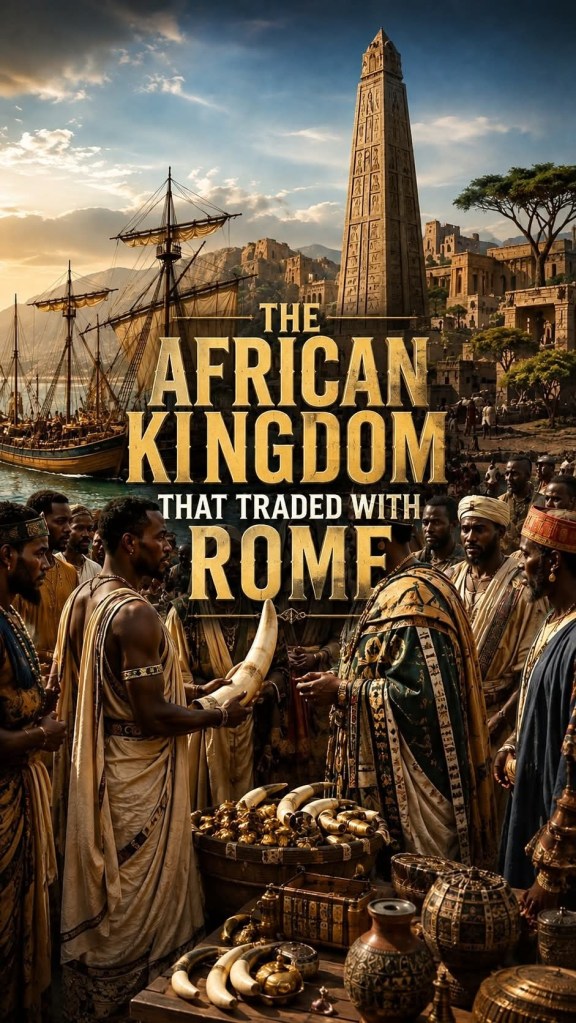
Aksum had a major commercial gateway called Adulis, located on the Red Sea coast.
Imagine the scene.
Ships arrive carrying goods from Arabia and the Indian Ocean.
Merchants unload their cargo.
African traders bring ivory, gold, animal products and other valuable commodities from the interior.
Foreign goods move inland toward Aksum.
And African goods move outward toward distant markets.
This was international commerce — thousands of years before the modern world existed.
Aksum even minted its own gold, silver and bronze coins.
Think about that.
A powerful African kingdom producing its own currency, placing its rulers’ names and images on coins, while participating in long-distance trade.
And the connections went even farther.
Aksum was connected to the commercial world of the Roman Empire.
It also participated in Red Sea and Indian Ocean trade, linking the Horn of Africa with Arabia and markets farther east, including India.
But Aksum wasn’t only about trade.
It had armies.
It had powerful kings.
It had monumental architecture.
It had its own written tradition, Ge’ez.
And under King Ezana in the 4th century, Christianity became established at the royal court, making Aksum one of the world’s early Christian kingdoms.
Then there are the enormous stone stelae of Aksum.
Massive monuments carved and raised centuries ago — some reaching more than 20 meters high.
And here’s where the story becomes really interesting.
Aksum didn’t simply sit on the sidelines while Rome, Arabia and India made history.
It interacted with them.
It traded with them.
It competed with them.
It influenced them.
And at certain points, Aksum even projected military power across the Red Sea into South Arabia.
So let’s stop for a moment and think about what that means.
Ancient Africa was not a continent disconnected from the rest of the world.
African merchants were moving goods.
African kings were issuing currency.
African ports were receiving international ships.
African kingdoms were participating in diplomatic, religious and military affairs beyond their immediate borders.
Aksum eventually declined as political and commercial conditions around the Red Sea changed.
But it didn’t simply “disappear.”
Its traditions survived and became part of the foundations of later Ethiopian civilization.
So here’s my question for you:
Why do you think civilizations like Aksum receive so little attention when people talk about the ancient world’s greatest trading powers?
Was Aksum simply overlooked by history?
Or have we been taught an incomplete version of ancient history?
Let’s debate respectfully in the comments.
And if you think more people need to know this side of African history, share this post.