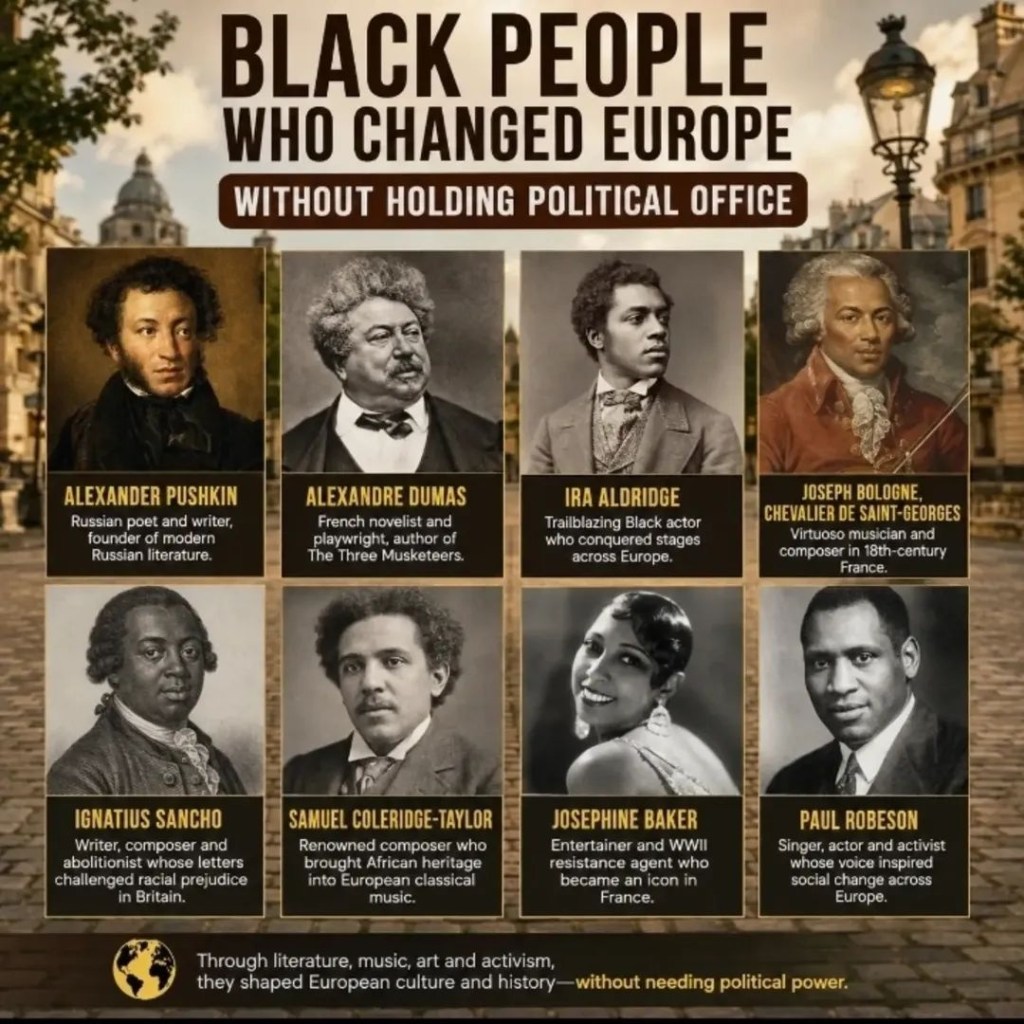
BLACK PEOPLE WHO CHANGED EUROPE — WITHOUT HOLDING POLITICAL OFFICE
BLACK PEOPLE WHO CHANGED EUROPE — WITHOUT HOLDING POLITICAL OFFICE
What if some of the people who most profoundly influenced European culture, literature, music, theatre and social thought never needed a political office to change history?
Long before diversity became a modern conversation, Black and African-descended people were already shaping European society—as writers, composers, performers, intellectuals, artists and activists.
Here are 8 remarkable examples whose influence reached far beyond their professions.
- 🇷🇺 Alexander Pushkin — Russia’s literary giant
Alexander Pushkin (1799–1837) is widely regarded as the founder of modern Russian literature.
What makes his story especially remarkable is his African ancestry. His great-grandfather, Abram Petrovich Gannibal, was an African-born nobleman and military figure who became part of the Russian imperial court.
Pushkin transformed Russian literature through poetry, novels, drama and prose. His works—including Eugene Onegin—helped establish the Russian literary language and influenced generations of writers.
His African ancestry was not simply an obscure genealogical footnote. Pushkin himself took pride in it, and scholars have examined how African heritage and identity appeared in his literary and personal world.
His weapon was not political power. It was the written word.
- 🇫🇷 Alexandre Dumas — The storyteller who conquered the world
Alexandre Dumas (1802–1870), author of The Three Musketeers and The Count of Monte Cristo, became one of the most widely read French writers of the 19th century.
Dumas was of mixed African and European ancestry. His father, Thomas-Alexandre Dumas, was the son of a French nobleman and an enslaved woman of African descent from Saint-Domingue.
Alexandre Dumas turned his family history into part of his identity while becoming a central figure in French Romantic literature.
His novels crossed borders and generations. Characters such as Athos, Porthos, Aramis and d’Artagnan became permanent fixtures of global popular culture.
His legacy demonstrates something important:
A person does not need to govern a country to influence how millions of people imagine courage, loyalty, adventure and justice.
- 🎭 Ira Aldridge — The Black actor who conquered European stages
Born in New York in 1807, Ira Aldridge moved to Britain in 1824 after facing severe discrimination against Black actors in the United States.
He went on to build an extraordinary career across Britain and continental Europe.
Aldridge became particularly famous for Shakespearean roles, including Othello. He toured extensively through Britain, Ireland and Europe and eventually became a British citizen.
His success was about much more than theatre.
Aldridge openly spoke to audiences about slavery and racial injustice, using his celebrity to challenge racist assumptions about Black intellectual and artistic ability.
The National Portrait Gallery notes that he performed in more than 250 theatres across Britain and Ireland and more than 225 theatres in Europe during his career.
Imagine the significance of that in the 19th century:
A Black man repeatedly walking onto European stages and demanding to be judged by his talent rather than his race.
- 🎼 Joseph Bologne, Chevalier de Saint-Georges — The Black virtuoso of France
Joseph Bologne, Chevalier de Saint-Georges (1745–1799), was born in the French Caribbean and became one of the most accomplished musicians in 18th-century Europe.
He was an extraordinary violinist, composer and conductor.
Saint-Georges became prominent in Parisian musical life and was associated with some of the most prestigious musical institutions of his era.
His achievements are especially striking because European society of the period was deeply structured by racial and social hierarchy.
He demonstrated that Black excellence in European classical culture did not begin in the modern era.
It was already present centuries ago.
And his story also reminds us that history is often more complicated than the categories we use today: Saint-Georges was both a celebrated Black musician and a military figure during revolutionary France. His influence therefore crossed music, culture and public life.
- ✍🏾 Ignatius Sancho — The writer who challenged assumptions about Black intellect
Ignatius Sancho (c. 1729–1780) was born into slavery but became a respected British writer, composer, shopkeeper and correspondent.
His letters became important evidence of the intellectual life of an 18th-century Black man living in Britain.
Sancho corresponded with prominent figures of his time and wrote about politics, society, race, culture and everyday life.
The British Library preserves surviving Sancho manuscripts and describes him as an author whose letters provide an important historical record.
His life was revolutionary in another sense.
At a time when racist ideas portrayed Africans and their descendants as intellectually inferior, Sancho was producing sophisticated literary correspondence and participating in Britain’s cultural world.
His existence itself challenged the stereotypes of his age.
- 🎼 Samuel Coleridge-Taylor — The composer who brought African heritage into European classical music
Born in London in 1875 to an English mother and a father from Sierra Leone, Samuel Coleridge-Taylor became one of Britain’s most prominent composers of African descent.
His music gained international attention, particularly his trilogy of works titled The Song of Hiawatha.
He also explored African and African-diasporic themes in his compositions, contributing to a growing recognition of Black musical identity within Britain’s classical tradition.
The British Library includes Coleridge-Taylor among the major figures in its history of Black music in Britain.
His career matters because classical music was often presented as an exclusively European cultural tradition.
Coleridge-Taylor proved that Black composers could occupy a major place within that tradition—and could also expand it.
- 🇫🇷 Josephine Baker — The entertainer who became part of France’s history
Josephine Baker was born in the United States but became an international star after moving to France.
She became famous in Paris during the Jazz Age, challenging European ideas about race, beauty, performance and modernity.
But Baker’s significance went beyond entertainment.
During the Second World War, she worked with the French Resistance and used her celebrity and international travel to assist the Allied cause.
After the war, she also became involved in the American civil-rights movement.
Her life illustrates how cultural influence can become political influence without requiring a person to hold political office.
- 🎭 Paul Robeson — The performer whose voice crossed borders
American actor, singer and activist Paul Robeson became a major international cultural figure during the 20th century.
His extraordinary bass-baritone voice and stage performances brought him fame in Britain and across Europe.
But Robeson also used his public platform to speak about colonialism, racism, workers’ rights and international solidarity.
His European career demonstrated the extraordinary political potential of culture: a singer and actor could enter spaces where formal political power was unavailable and still influence public debate.
🌍 THE BIGGER STORY
These individuals did not all share the same nationality, background or political views.
Some were born in Africa or the Caribbean.
Some were born in Europe.
Some were African American immigrants who found greater professional opportunities in Europe.
Some were of mixed African and European ancestry.
And their experiences were not uniformly positive. Many encountered racism, discrimination, stereotyping or attempts to minimize their achievements.
That is precisely why their stories matter.
They entered European societies in different centuries and different circumstances—and left fingerprints on European civilization through culture rather than political office.
They changed:
📚 Literature — Pushkin, Dumas, Sancho
🎭 Theatre — Ira Aldridge, Josephine Baker, Paul Robeson
🎼 Classical music — Saint-Georges, Coleridge-Taylor
✊🏾 Social thought and activism — Sancho, Baker, Robeson and Aldridge
And their influence did not stop at Europe’s borders.
Their books, music, performances and ideas travelled around the world.
🔥 HISTORY HAS NEVER BEEN ONLY ABOUT PRESIDENTS, PRIME MINISTERS AND KINGS.
Sometimes history is changed by the person holding a pen.
Sometimes by the person holding a violin.
Sometimes by the person standing beneath a theatre spotlight.
Sometimes by the person whose voice refuses to be silenced.
These Black and African-descended figures did not need political office to help reshape Europe.
They changed Europe by changing its culture, imagination and understanding of Black achievement.
And there are many more whose names deserve to be remembered.
Which person on this list surprised you the most? 👇🏾
And if you know another Black person who profoundly influenced Europe without holding political office, drop their name in the comments. Let’s expand this history together.