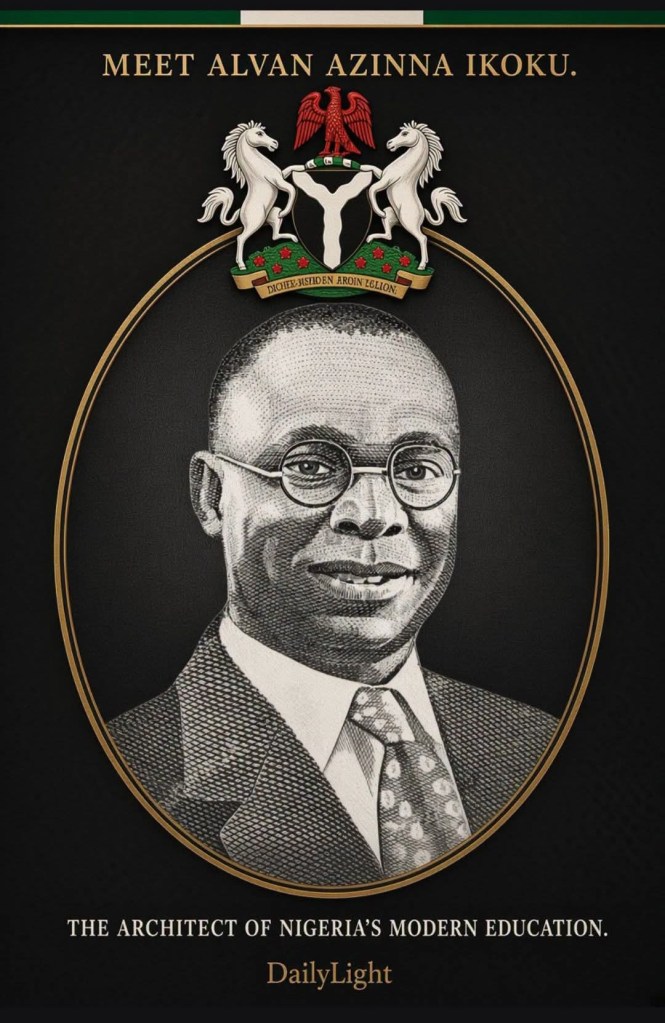
MEET ALVAN AZINNA IKOKU, THE TEACHER WHO WANTED EDUCATION TO BUILD BOTH THE MIND AND THE HANDS
MEET ALVAN AZINNA IKOKU, THE TEACHER WHO WANTED EDUCATION TO BUILD BOTH THE MIND AND THE HANDS 🇳🇬
Long before his face appeared on the Nigerian ₦10 note, Alvan Azinna Ikoku was simply a young boy from Arochukwu who had begun to understand that education could change the destiny of a people.
He was born on August 1, 1900, in Amanagwu, Arochukwu, present-day Abia State, into a successful merchant family. His father died about three months before his birth, and he was given the name Azinna, meaning “one who comes after his father.” He was largely brought up by his maternal relations.
From Arochukwu Government School, young Alvan eventually found himself at Hope Waddell Training Institution in Calabar, where something remarkable was happening around him.
His classmates included young men who would later become important figures in Nigerian history, among them Francis Akanu Ibiam and Eyo Ita. At that time, however, they were simply students sitting in the same school environment, learning and imagining what their futures might become.
And then there was a teacher who left a particularly deep impression on Ikoku, James Emmanuel Kwegyir Aggrey, the celebrated Ghanaian educationist popularly known as Aggrey of Africa.
In 1920, while Ikoku was at Hope Waddell, he listened to Aggrey speak about the power of education and the responsibility of Africans to develop themselves. The young Ikoku was deeply inspired.
Aggrey was not merely a teacher to him. He became a mentor whose philosophy would influence the direction of Ikoku’s entire life.
Ikoku went into teaching himself.
While working as a teacher and later as a senior tutor at St. Paul’s Teachers’ Training College, Awka, he continued his own education through correspondence. In 1928, he obtained a B.A. in Philosophy from the University of London through its external programme.
But perhaps the most important question he asked himself was:
What is the purpose of education if the knowledge acquired cannot be used to build society?
In 1932, he answered that question by founding Aggrey Memorial College in Arochukwu, naming the school after the Ghanaian teacher who had inspired him.
The school became Nigeria’s first wholly indigenous private secondary school, and Ikoku gave it an educational philosophy that was ahead of its time. He introduced practical training, including carpentry, and described it as “the Education of the Hand.” Students were not expected to learn only from books; they were encouraged to develop practical abilities and learn how to make things with their own hands.
This was Alvan Ikoku’s great message: education should develop the whole person.
He did not stop at running a school.
He entered public life, served in the Eastern Nigeria House of Assembly, later represented the Eastern Region in the Legislative Council in Lagos, and became a major voice in the Nigerian Union of Teachers. He pushed for reforms that affected teachers, schools and educational policy.
In 1962, he advocated an Education Bill of Rights calling for six years of free primary education. His campaign became part of the wider movement for greater access to education in Nigeria.
He was honoured during his lifetime, including being appointed an Officer of the Order of the British Empire (OBE) in 1949.
Alvan Ikoku died in 1971, but Nigeria refused to let his name disappear.
His portrait was placed on the ₦10 note, and his name lives on through the Alvan Ikoku Federal College of Education in Owerri and Alvan Ikoku Way in Abuja.
Think about that for a moment.
The Ghanaian teacher who inspired him became the namesake of the school he founded.
The schoolmate who sat beside him at Hope Waddell, Akanu Ibiam, would later become Governor of Eastern Nigeria.
And Alvan Ikoku himself would become one of the men whose ideas helped shape the way Nigerians thought about education.
That is why his story deserves to be remembered.
Not simply because his face appeared on our currency, but because behind that face was a man who believed that a child should leave school with more than certificates, with knowledge, character, practical ability and a sense of responsibility to society.
Alvan Azinna Ikoku, 1900–1971.
A teacher who became a reformer.
A student who became a mentor.
And an educationist whose influence reached far beyond the classroom.
When you see his face on the ₦10 note, now you know the story behind it.