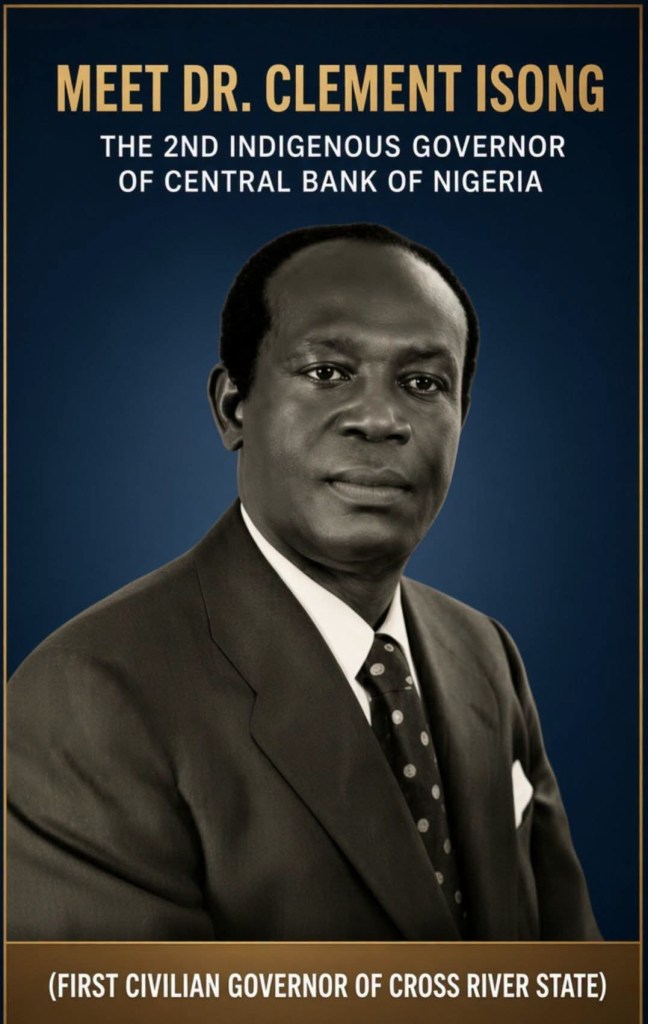
MEET DR. CLEMENT NYONG ISONG, THE MAN WHO WAS PASSED OVER, RETURNED FROM WASHINGTON, AND ENDED UP ON THE ₦1,000 NOTE
MEET DR. CLEMENT NYONG ISONG, THE MAN WHO WAS PASSED OVER, RETURNED FROM WASHINGTON, AND ENDED UP ON THE ₦1,000 NOTE
Before his face appeared on Nigeria’s ₦1,000 note, before he became one of the most important figures in Nigeria’s monetary history, and before he became the first elected civilian Governor of the old Cross River State, Clement Nyong Isong had already lived a remarkable story of education, disappointment, service and resilience.
Dr. Clement Nyong Isong was born on April 20, 1920, in what the Central Bank of Nigeria identifies as Ikot Osong, now Ikot Udo Esang in the Awa Clan of present-day Onna Local Government Area, Akwa Ibom State.
His early education began at Qua Iboe Primary School in Ikot Udo Esang. He later completed his primary education in Oron and attended the Oron Training Institute, which later became Methodist Boys High School, Oron.
But Isong was not satisfied with ordinary education.
In 1950, he entered University College Ibadan, where he obtained a diploma in Education. Then came the opportunity that would change his life.
He won scholarships from the Ford Foundation and Rockefeller Foundation to study Economics at Iowa Wesleyan College in the United States.
He graduated in 1954 with a bachelor’s degree, reportedly summa cum laude.
And he did not stop there.
He continued his graduate studies at the Howard Graduate School of Arts and Sciences in Massachusetts, where he earned master’s and doctoral degrees in Economics.
This is one part of his story that is sometimes incorrectly reported: official CBN records identify the institution as Howard Graduate School, not Harvard.
After his studies, Isong worked briefly as an economist at the Federal Reserve Bank of New York.
But instead of remaining in America, he returned to Nigeria.
He joined the University of Ibadan, where he lectured in Banking and Economics.
Then, as Nigeria prepared for independence, another opportunity came.
In 1958, Isong left the university and joined the newly established Central Bank of Nigeria as its Secretary. He later became Director of Research.
Think about the significance of that moment.
Nigeria was building institutions that would eventually carry an independent nation.
And Isong was not simply watching from the sidelines.
He was helping build one of the country’s most important financial institutions.
He also became deeply involved in developing the research capacity and indigenous expertise of the young Central Bank.
Then, in 1962, his career took another international turn.
He was seconded to the International Monetary Fund in the United States, where he served in different capacities, including as an adviser in the African Department.
For several years, he worked at the centre of international monetary affairs.
Then Nigeria called him home.
In August 1967, Clement Isong became Governor of the Central Bank of Nigeria.
He was the country’s second indigenous CBN Governor, succeeding Alhaji Aliyu Mai-Bornu, who had become the first indigenous Governor in 1963.
And the timing could hardly have been more difficult.
Isong assumed office on August 15, 1967, just weeks after the Nigerian Civil War had begun.
He would remain Governor for more than eight years, until September 22, 1975.
Those years placed him at the centre of some of the most difficult economic decisions in Nigeria’s history.
The country was fighting a devastating war.
Government finances were under enormous pressure.
The currency system itself became part of the conflict.
In 1968, Nigeria changed the colour and design of its currency notes, a move closely connected with the wartime monetary strategy.
The objective was to prevent large quantities of currency circulating outside federal control from retaining their previous value.
Isong therefore found himself managing the country’s central banking system while monetary policy had become inseparable from national survival.
But his CBN story did not end with the war.
Nigeria was moving into a completely new economic era.
In 1973, the country replaced the Nigerian pound, shilling and pence system with a new decimal currency.
The naira was born.
And Clement Isong was the Central Bank Governor responsible for guiding the institution through that historic transition.
He had helped build the CBN.
He had returned from international monetary service to lead it during war.
And he remained at the helm as Nigeria introduced its own national currency.
After eight years as Governor, Isong left the CBN in September 1975 following the change in military government.
But retirement from the Central Bank did not mean retirement from public life.
He entered consulting and remained involved in economic and national affairs.
Then came another extraordinary chapter.
In 1979, Nigeria returned to civilian rule.
Clement Isong entered politics under the National Party of Nigeria and won the governorship election in the old Cross River State.
He became the first elected civilian Governor of Cross River State.
The economist who had once managed Nigeria’s central bank was now responsible for governing an entire state.
During his administration, initiatives were associated with industrial development, infrastructure and the expansion of educational institutions in the state.
Among the projects associated with his administration were industrial ventures and the establishment of the institution that became the University of Cross River State.
His story was therefore no longer simply about banking.
It had become a story about nation-building.
In 1982, he was honoured by the Federal Government with the national honour of Commander of the Order of the Federal Republic, CFR.
He later continued participating in public affairs and served in several national and institutional capacities.
Clement Nyong Isong died on May 29, 2000, at the age of 80.
But Nigeria did not completely forget him.
In 2005, when the ₦1,000 note was introduced into circulation, his portrait appeared on it alongside the portrait of Alhaji Aliyu Mai-Bornu, the first indigenous Governor of the Central Bank of Nigeria.
There is something almost poetic about that.
Mai-Bornu became the first indigenous CBN Governor.
Isong succeeded him as the second.
Both men eventually found themselves together on the same Nigerian banknote.
And that is why Clement Isong’s story deserves more than a few lines in a history book.
He was a scholar who crossed the Atlantic for education and came back home.
He was an economist who worked at the Federal Reserve Bank of New York but chose to return to Nigeria.
He helped build the Central Bank of Nigeria from its early years.
He served as Governor during one of the most turbulent periods in the nation’s history.
He guided the country’s monetary system through war and through the transition from the Nigerian pound to the naira.
He left the Central Bank and later returned to public service as the first elected civilian Governor of Cross River State.
And decades after all of that, his face became part of the everyday currency carried in the pockets of millions of Nigerians.
Clement Isong’s life reminds us that sometimes a person’s greatest chapter begins after the chapter everyone thought had ended.
He was an economist.
A banker.
A central banker.
An international monetary adviser.
A wartime CBN Governor.
A politician.
A state governor.
And eventually, a face on the Nigerian currency.
This was Dr. Clement Nyong Isong, one of the men who helped build Nigeria’s financial history.