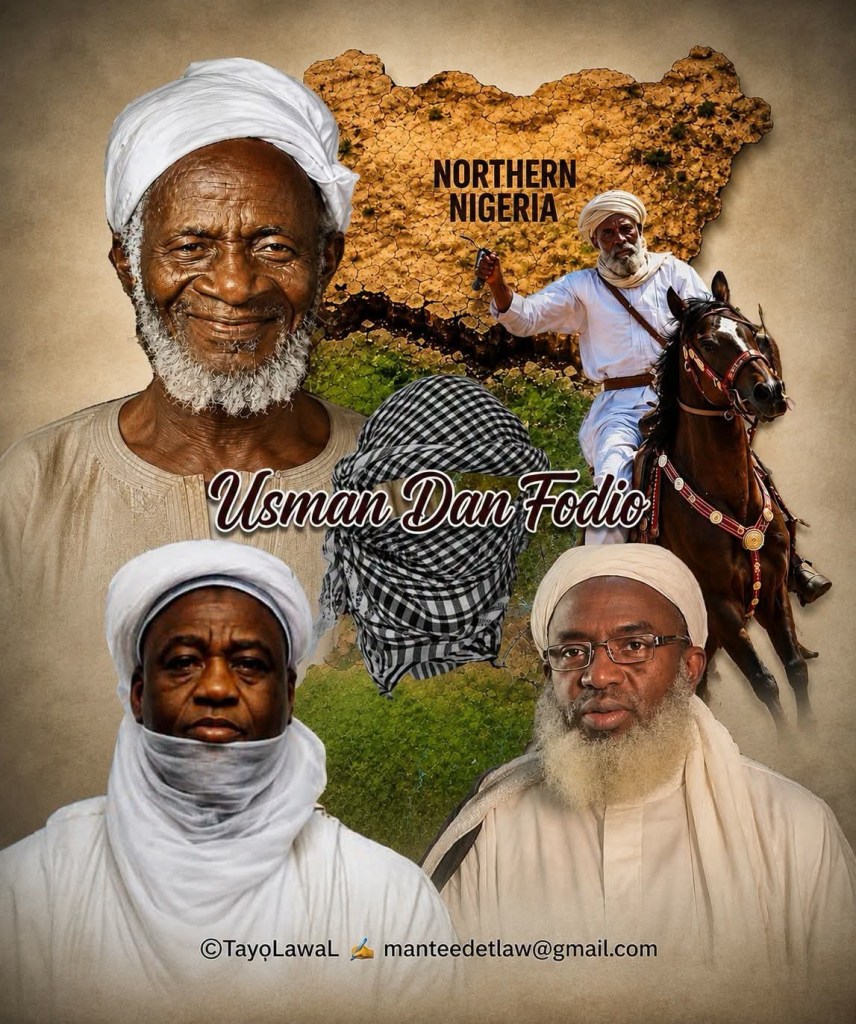
Before you call it ‘banditry,’ read the history.
Before you call it ‘banditry,’ read the history.
In this two-part series, I trace the Fulani journey from the Senegambia river valley to the Sokoto Caliphate, from the Jálumi War to modern insurgency.
Part 1: Origins & Conquest. Part 2: Hegemony & The Future.
Read Part 1 first – or you’ll miss the historical receipts.
READ THE FULL ESSAY BELOW 👇🏿
“Must It Be ‘Everywhere Is War’?”: The Fulani Question – Origins & Conquest (Part 1)
People often misattribute the famous quotation to Bob Marley.
They are wrong.
The words did not first echo from a recording studio in Kingston, Jamaica.
They were spoken in October 1963, before the United Nations General Assembly, by Emperor Haile Selassie I of Ethiopia – the Lion of Judah, the man Rastafarians revere as the returned Messiah.
His voice, heavy with the weight of African history, warned that the philosophy of racial superiority would inevitably breed conflict.
“Until the philosophy which hold one race superior and another inferior is finally and permanently discredited and abandoned – everywhere is war.”
More than a decade later, Bob Nesta Marley plucked those words from Selassie’s speech and set them to a heartbeat rhythm on his 1976 album Rastaman Vibration.
Marley did not claim authorship; he amplified it, turning a diplomatic warning into a global anthem.
“War” became a rallying cry, its lyrics a mirror held up to a world still bleeding from the wounds of supremacy and conquest.
It is fitting that we begin with Marley’s adaptation of Selassie’s warning.
In Nigeria today, the philosophy Selassie condemned has not been abandoned.
It has simply changed uniforms, from the turban of the 19th-century jihadist to the balaclava of the 21st-century bandit, from the sword of the Caliphate to the AK-47, AK-49, of the kidnapper.
The war Selassie foresaw is not coming; it is already here.
At its center stands a question that 200 million Nigerians can no longer ignore: What happens when 6% of the population wages war against the remaining 94%, and wins?
History is not a mere chronicle of events; it is a mirror.
And as George Santayana warned:
“Those who cannot remember the past are condemned to repeat it.”
Before the Sokoto Caliphate, before the conquest of Hausaland, there was the Senegambia river valley.
Historical records and genetic studies trace the Fulani’s origins to the region between the Senegal and Gambia rivers, beginning around the 11th century CE.
This was their heartland, the cradle from which they would spread across West Africa.
From Senegambia, they migrated eastward into Futa Toro in the Middle Senegal Valley and later into the Futa Jallon highlands in present-day Guinea.
Those highlands, mountainous and agriculturally rich, became a sanctuary for Fulani pastoralists migrating in large numbers from the 15th and 16th centuries.
There is also a competing theory, one that Fulani oral traditions themselves assert.
They claim an “Eastern origin” for their race.
While these are legends, scholars note that “there is generally a foundation of truth in native legends.”
Anthropological studies lend weight to this theory.
Dr. Verneau examined skulls of Fulani chiefs from Futa Jallon and found cranial and facial characteristics of the “Ethiopian” (Abyssinian) type, with affinities to the ancient Egyptian population.
Dr. Blyden, who visited Timbo, the capital of Futa Jallon, observed a “Caucasian cast of features” among Fulani, particularly among older people, suggesting “a large infusion of foreign blood” alongside an “inextinguishable Negro physiognomy.”
Fulani oral traditions “suggest an origin in Egypt or the Middle East, a common theme in West African Muslim traditions.”
Genetic studies confirm that Fulani carry around 20% non-sub-Saharan (Eurasian/North African) ancestry, traceable to the Green Sahara period (12,000–5,000 years ago), when cattle pastoralists first appeared in North Africa.
This adds a fascinating layer.
It suggests the Fulani are not simply “West Africans” – they carry ancient North African and Eurasian ancestry that may explain their historical sense of cultural and religious superiority over surrounding peoples.
This connects directly back to Haile Selassie’s warning about the philosophy of racial superiority.
It also explains why the Fulani saw themselves as a chosen people with a divine mandate to conquer.
The pattern of conquest did not begin in Nigeria, it began in the highlands of West Africa.
In 1725, the Fulani community in Futa Jallon, led by their Muslim clerical faction, launched a jihad against the indigenous Jalonke people, whom they deemed “pagans.”
The leader, Ibrahim Musa, was elected Al-Imam, and his successor, Ibrahim Sori, completed the conquest by 1776.
The new Fulani aristocracy drove out the natives, enslaved many, and established a Muslim theocracy that would become the model for future Fulani jihads.
Nearby, in Futa Toro along the Senegal River, a parallel jihad unfolded.
In 1776, the very same year Sori completed his conquest, a Fulani cleric named Sulayman Bal launched a similar jihad against the Denyanke dynasty.
His successor, Abdul Kader, became the first almami of the theocratic Imamato of Futa Toro.
He expanded aggressively, defeating the emirates of Trarza and Brakna to the north, though he was later captured trying to attack Wolof states.
After his death in 1806, the jihad lost momentum, and the state lasted until 1859, when the French annexed it.
In both cases, Futa Jallon and Futa Toro, the pattern was identical.
Fulani pastoralists and clerics migrated into a region, consolidated their community, declared jihad against non-Muslim rulers, and established Fulani aristocracy.
This was the blueprint that Uthman dan Fodio would later replicate in Hausaland, drawing inspiration from these earlier “revolutions.”
The 1725-1776 Futa Jallon jihad and the 1776 Futa Toro jihad prove that Fulani conquest was not a one-off event, it was a broader revolutionary movement unfolding across multiple West African regions.
By 1804, when Dan Fodio launched his jihad, the model was already well-established.
As Professor Akintoye notes, this pattern of migration, settlement, then upheaval continued when the Fulani “came in about the 18th century and began to live in the towns of the Hausa people.”
But the blueprint was forged in Futa Jallon and Futa Toro, centuries before the Sokoto Caliphate existed.
The Fulani did not sweep into Northern Nigeria as a single invading army.
Their incursion was gradual and pastoral.
For centuries, they were primarily Cattle Fulani (Fulanin Bororo), moving southward in search of grazing land.
They remained on the periphery of the Hausa states, focused on their herds, organized in lineage groups led by an ardo.
They were mostly un-Islamized, living alongside but separate from the Habe rulers.
Then the game changed.
A Fulani religious teacher named Uthman dan Fodio turned the Fulani presence into a political revolution.
In 1804, expelled from the Hausa state of Gobir, he declared a jihad against the Habe rulers.
His call was not just for religious purity but for a new political order.
His armies, Fulani and Hausa supporters alike, swept across the region, overthrowing established dynasties and conquering major city-states like Kano, Katsina, and Sokoto.
This created the Sokoto Caliphate, one of the largest empires in 19th-century Africa, covering most of Northern Nigeria and parts of Niger and Cameroon.
It was the pivotal moment the Fulani transitioned from peripheral herders to the ruling class.
A new Fulani elite, the Sarakuna, took political control, imposing governance based on Islamic law.
They were no longer just an ethnic group; they were empire builders and rulers.
The North was now Fulani-led and Islamic.
As Lord Acton observed:
“Power tends to corrupt, and absolute power corrupts absolutely.”
Dan Fodio was not merely a military leader, he was a prolific intellectual.
He wrote numerous Arabic works declaring the legitimacy of his jihad and governance.
His Sirāj al-ikhwān fī ahamm mā yuḥtāju ilay-hi fī hādhā al-zamān (The Lamp of Brethren Regarding the Most Significant Thing Needed in This Era), written in 1811, reveals how he carefully reorganized religious and political knowledge to vindicate his activities.
He was substantially influenced by the 16th-century Maliki jurist Muhammad al-Maghīlī (d. c. 1505).
But through selective quotations and manipulative interpretations, Dan Fodio reorganized al-Maghīlī’s arguments to justify his own political activities.
During the jihad, he divided the people of Hausaland according to their beliefs and proposed regulations for capturing and enslaving “unbelievers.”
He introduced a “thought of tolerance” that permitted less authoritative views, while simultaneously manipulating regulations to expand the category of unbelievers who could be lawfully captured.
This ideological framework provided religious justification for conquest and subjugation, a pattern that would echo for centuries.
Historian Murray Last observed that the Sokoto Caliphate was “the most important state in the region until its conquest by the British in the early 20th century.”
Later empire-builders explicitly followed Dan Fodio’s example, leading scholars to speak of a “Sokoto model of jihad.”
As the Caliphate grew, its forces pushed south into Yorùbá territories, collapsing the Ọyọ Empire when Ilọrin seceded and joined the Sokoto troops.
The Fulani foothold in the southwest did not begin with a direct invasion.
It began with a strategic alliance that turned into a takeover.
Afọnja, the Kakanfo of the Ọyọ Empire, invited a Fulani Islamic scholar and military leader named Alimi to help him rebel against the Alaafin.
It backfired.
Alimi and his forces exploited Afọnja’s hospitality, gained control, and established an emirate, turning Ilorin from a Yorùbá outpost into a base for Fulani expansion.
The emirates of Nupe and Ilọrin were both products of the 19th-century Sokoto jihad.
By the second half of the 19th century, the Fulani had eclipsed the Nupe ruling dynasty, partitioning the kingdom under their control.
The battle that stopped them, temporarily, was the Jalumi War on November 1, 1878.
It was part of the Kiriji War, a series of Yorùbá civil wars between 1793 and 1893.
At Jalumi, a coalition of Ilọrin, Ekiti, Ila, and Ijẹsa forces fought against the powerful Ibadan army.
The Ibadan forces were commanded by Balogun Ajayi Ogboriefọn, whose tactical skill secured victory.
The battle was brutal.
The attacking forces came in three groups: the Ilọrins under Ajia to the northeast, the Ilas under Prince Adeyale and Ekitis under Fabunmi nearby, and the Ijẹsas to the east led by Ayimoro and Ogunmọdẹde.
The Ibadan army entered Ikirun on October 31.
On November 1, the three besieging forces advanced.
Ogboriefọn cleverly maneuvered his troops, ruthlessly destroyed the Ijẹsas, returned to defeat the Ilọrins, and finally crushed the demoralized Ekitis and Ilas.
The victory was complete.
The decisive moment came when the people of Ọfa, hearing the Ilọrins retreating, cut the bridge across the Ọtin River.
The Ilọrins were pushed into the flooded river, and thousands of men, women, and horses drowned.
The name “Jalumi” means “drown in the river” in Yorùbá.
Historian Samuel Johnson, in his classic, The History of the Yorubas, documented that the Ilọrin establishment had joined the war as an opportunity to fulfill its imperial ambitions.
The reigning emir told his people:
“The Kaffirs (infidels) are at war with one another, and we should combine against this Ibadan which has often baulked us of our prey.”
He also spoke of using the conflict to “yet carry the Quran to the sea”, a clear declaration of expansionist intent.
The defeat did not dissolve the Confederacy.
Fabunmi, the Ekiti war chief who initiated the revolt, declared he had to take “a deeper interest” in the war than anybody else, because “had it turned out that the Ekitis failed to unite in resistance, or the Ibadans succeeded in inflicting heavier calamities upon our country, my name and my people would be subject to everlasting execration from all our tribes on account of my presumption.”
Ilọrin’s presence in Jalumi was part of a military tradition where the end justified the means.
The Fulani were, as one commentator observed, “willing partner to any Yorùbá group desirous or worthy of his comradeship.”
But the Fulani were not finished.
They would return, not with swords, but with British guns and colonial power.
END OF PART 1