KOGI AND THE BIAFRA QUESTION: LET HISTORY SPEAK!
KOGI AND THE BIAFRA QUESTION: LET HISTORY SPEAK!
For years, many people hear the word Biafra and immediately think only of the present five South-Eastern states.
But history is more complicated than today’s political map.
The question being raised by some contemporary Biafran territorial proposals is this:
WHAT ABOUT THE PARTS OF KOGI THAT HAVE HISTORICAL, CULTURAL, LINGUISTIC AND MIGRATION CONNECTIONS WITH THE EASTERN NIGERIAN WORLD?
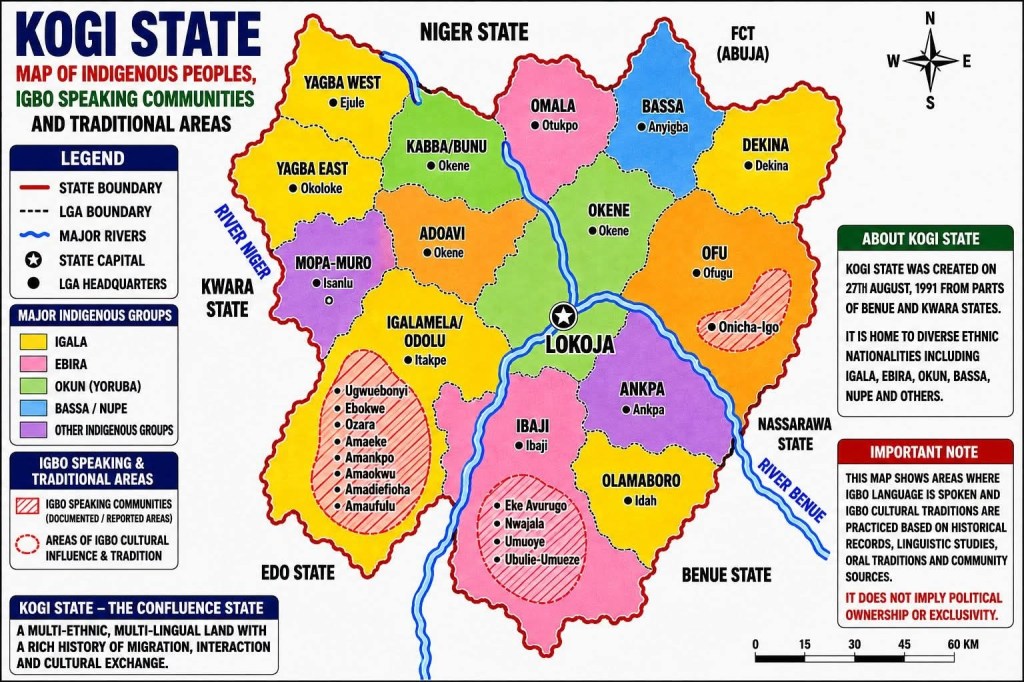
Kogi is not historically one single ethnic territory. It is a meeting point of peoples and civilizations around the Niger–Benue confluence.
The state contains communities associated with:
🔹 Igala
🔹 Igbo-speaking communities
🔹 Ebira
🔹 Okun
🔹 Bassa
🔹 Nupe
🔹 Oworo
🔹 Kakanda
🔹 Kupa
🔹 Other indigenous communities
There are also documented areas of Igbo–Igala linguistic and cultural contact, particularly around parts of Ibaji and Igalamela/Odolu.
So the debate cannot simply be:
«“Kogi is not Biafra.”»
The deeper historical question is:
WHICH PART OF KOGI? WHICH PEOPLE? WHICH COMMUNITY? WHAT IS THEIR HISTORY?
If a community has an ancestral, linguistic, cultural or historical connection with the peoples of the wider Biafran proposal, that history deserves to be examined.
But we must also be honest:
Historical connection does not automatically mean that every person in Kogi identifies as Biafran.
That is why this conversation should be based on evidence—not insults.
📍 Kogi must be studied community by community.
Ask:
- Who are the original inhabitants?
- Where did their ancestors come from according to oral traditions?
- What language did they historically speak?
- What kingdoms, clans or political institutions existed there?
- What relationships did they have with Igbo, Igala, Idoma, Ebira, Nupe and neighbouring peoples?
- Which communities have Igbo-speaking populations or documented Igbo cultural connections?
- And most importantly—what do those communities themselves say about their identity and political future?
The modern map of Kogi was created in 1991.
Our ancestors did not wake up one morning and find a sign saying:
“WELCOME TO KOGI STATE.”
The people and their histories existed long before the modern state boundary.
🔥 SO, IS PART OF KOGI HISTORICALLY CONNECTED TO THE BIAFRAN QUESTION?
That is a historical question worth investigating.
And if someone says:
“My community is not Biafra.”
Fine.
Don’t fight.
Tell us the history of your community.
Because history is stronger than slogans.
📖 STUDY HISTORY. TRACE THE PEOPLE. EXAMINE THE EVIDENCE. THEN FORM YOUR OPINION.
THE 13 BIAFRA STATES
Tracing Ancestral Roots, Migrations, Peoples, Territories, and the Evolution of a Contested Homeland.