
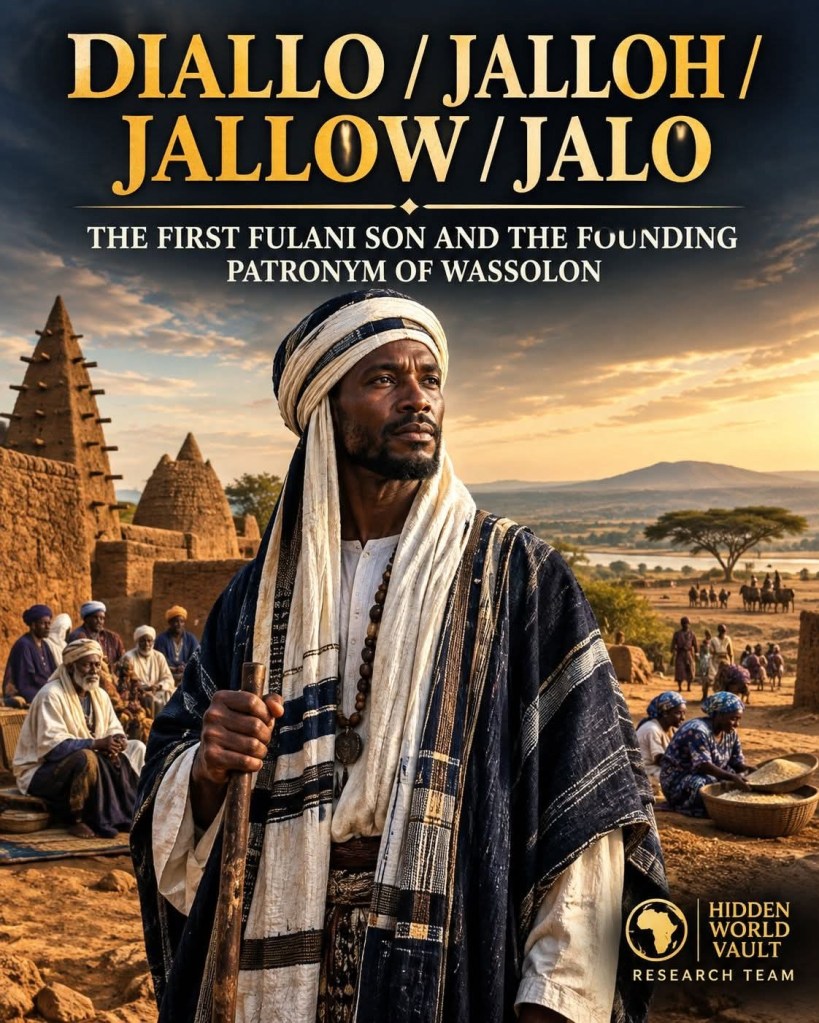
DIALLO/JALLOH/JALLOW/JALO: THE FIRST FULANI SON AND THE FOUNDING PATRONYM OF WASSOLON
DIALLO/JALLOH/JALLOW/JALO: THE FIRST FULANI SON AND THE FOUNDING PATRONYM OF WASSOLON
The Forgotten Story Behind One of West Africa’s Most Powerful Names
- INTRODUCTION
Millions of people across West Africa carry the name Diallo.
But behind this familiar patronym lies a much deeper question:
Where did the name come from, and what did Diallo originally represent?
According to Wassolonké oral traditions, Diallo was more than a family name. It was a name associated with lineage, authority, leadership and the political organization of the Wassolon space.
The tradition remembers Foula Massa Djan Diallo as one of the foundational figures of this history, described as a king of kings and supreme authority over the twelve traditional provinces of Wassolon.
This was not the modern political map of Guinea, Mali or Côte d’Ivoire.
The story belongs to an older world, when political communities were organized through kingdoms, chiefdoms, villages, clans, families, alliances and ritual institutions that existed long before today’s national borders.
And at the heart of this memory stands Wassolon.
2 THE TWELVE PROVINCES
Wassolonké tradition describes Wassolon as an organized political territory divided into twelve traditional provinces.
Each province had its own authority, while the wider system recognized a central leadership.
The traditional accounts place Kangbela at the center of this political and ritual organization.
It was remembered as a place where important decisions affecting the wider community were made.
The tradition therefore presents Wassolon not simply as a geographical area, but as a political and cultural system with its own hierarchy, leadership and institutions.
- FOULA MASSA DJAN DIALLO
At the center of this tradition is Foula Massa Djan Diallo.
He is remembered as the king of kings, supreme chief of the twelve provinces and an authority whose influence extended across numerous villages.
Some versions of the tradition speak of 362 villages under this wider political structure.
Whether every detail of this traditional account can be independently established is another question.
But the preservation of the story itself is historically important.
It tells us how Wassolonké communities remembered their political past and the authority of their ancestors.
- WHY THE NAME DIALLO MATTERS
The significance of Diallo, within this tradition, goes beyond the modern idea of a surname.
The patronym became connected to power, family, legitimacy and social identity.
And this raises a fascinating question:
Could some West African patronyms preserve memories of ancient political roles, titles, personal characteristics or social institutions?
Across West Africa, names have not always remained fixed.
People migrated.
Families divided.
Political structures changed.
Individuals acquired new names.
Titles sometimes became hereditary names.
And communities sometimes adopted or abandoned patronyms.
That means the history of a surname cannot always be reconstructed simply by looking at everyone who carries it today.
- DJEDI SIDIBÉ AND BATÈ
Another important figure in the Wassolonké tradition is Djedi Sidibé.
He is remembered as a ruler associated with the villages of Batè and with a political movement that eventually contributed to the establishment of a separate political center.
Within local memory, this became connected with the formation of the Batè political entity, remembered as one of the later major Fulani political formations connected to the broader Wassolon story.
These traditions deserve deeper investigation through oral history, genealogy, linguistics, archaeology and documentary records.
- THE DIVISION OF WASSOLON
Perhaps one of the most powerful parts of the tradition is the explanation for the eventual fragmentation of Wassolon.
The story says that the different provinces were once connected through family relationships, political authority and common ritual practices.
But disagreements among heirs eventually led to the division of territories.
The political structure fragmented.
The families remained.
The memories remained.
And the names remained.
This is one of the reasons patronyms are so important to African historical research.
A name can sometimes carry memories long after the political institution that produced or elevated it has disappeared.
- DIALLO AND THE PULAAR LANGUAGE
Wassolonké tradition also associates the name Diallo with laughter or smiling in Pulaar.
Some traditional explanations connect the meaning with the idea of possessing strength or strategic intelligence while maintaining a smile.
This is an important distinction for researchers:
An oral explanation of a name is not automatically the same thing as a scientifically established linguistic etymology.
The traditional explanation should be preserved, documented and compared with evidence from historical and comparative linguistics.
That is how we respect tradition without confusing tradition with proof.
- FULANI AND MALINKÉ: A SHARED HISTORY
The Wassolon story also reminds us that the history of Fulani and Malinké communities cannot be reduced to endless separation or conflict.
The peoples of this region interacted for centuries through migration, trade, marriage, political alliances, warfare, cultural exchange and shared institutions.
Their histories crossed.
Their families crossed.
Their languages influenced one another.
And their memories often became intertwined.
This is why African history becomes much more interesting when we move beyond modern ethnic and national boundaries.
- THE BIGGER QUESTION
So when you hear the name Diallo, don’t think only about a surname.
Ask:
● What historical memories does the name carry?
● What traditions connect Diallo with Wassolon?
● Who was Foula Massa Djan Diallo?
● What was Kangbela?
● What did the twelve provinces represent?
● Who was Djedi Sidibé?
● How did Wassolon become politically fragmented?
And perhaps the most important question:
● How much of this history is still preserved inside the memories and genealogies of Wassolonké families today?
That is where the real investigation begins.
At Hidden World Vault, we are not interested in simply repeating old stories.
We want to document them, compare them, question them and preserve them.
Because an oral tradition should neither be blindly accepted nor casually dismissed.
It should be investigated.
The name Diallo is widespread.
The story behind it may be even wider.
DIALLO: THE FIRST FULANI SON AND THE FOUNDING PATRONYM OF WASSOLON
A story of names, power, lineage, memory and the forgotten political history of West Africa.
Hidden World Vault Research Team:
N’fa Aliyah Camara-Jomande
Mohamed Sacko Camara
SELECTED REFERENCES
- Diallo, Aboubacar. “La parole comme moyen d’éducation : cas du chant traditionnel chez les Wassolonka de Mandiana en Guinée.” Cahiers Africains de Rhétorique, Vol. 4, No. 2, 2025, pp. 194–203. This study is particularly useful for documenting Wassolonka oral traditions, social organization, patronyms, and the transmission of historical memory through oral performance.
- Camara, I. Le cadre rituel de l’éducation au Mali : l’exemple du Wassoulou. Paris: L’Harmattan, 2002. This work examines traditional institutions and ritual life in Wassoulou and is listed among the scholarly references used in research on Wassolonka traditions.
- Studio Tamani. “Yanfolila : les ‘Diallo’ du Wassoulou intronisent leur patriarche.” 20 March 2017. This report documents the traditional institution of a Diallo patriarch in Wassoulou and the continuing role of the Diallo lineage within local tradition.
- Iffono, Aly Gilbert. Lexique historique de la Guinée-Conakry. The work is cited in discussions of Wassoulou traditions, including oral accounts concerning the settlement and formation of Wassolon communities.
- Thierno Diallo. Les institutions politiques du Fouta Dyalon au XIXe siècle (Fii laamu alsilaamaaku Fuuta Jaloo). Dakar: IFAN, 1972. Useful comparative scholarship for understanding the political organization, provinces, leadership structures and historical interaction of Fulani and Manding societies in the wider Upper Guinea region.
- Barry, Alpha Amadou Bano. “Comment la Guinée a-t-elle été peuplée?” This study discusses the historical settlement of Wassoulou and the interaction between Fulani and Malinké populations, including the persistence of patronyms such as Diallo, Diakité, Sidibé and Sangaré.
- Camara, Laye. Chanson maninka. Diplôme d’Étude Supérieure, IPGAN, 1966. Relevant for the broader study of Manding oral traditions and cultural transmission.
- Cherif, A. L’importance de la parole chez les Manding de Guinée : paroles de vie, paroles de mort et rituels funéraires. Paris: L’Harmattan, 2005. Useful for understanding the role of oral transmission, ritual speech and historical memory among Manding communities.
IMPORTANT SOURCE NOTE
The specific accounts of Foula Massa Djan Diallo, the twelve provinces, Kangbela, 362 villages, and the political genealogy connecting these figures should be identified as Wassolonké oral traditions/local historical traditions unless independent documentary, archaeological or genealogical evidence is found to corroborate each detail.
Likewise, the explanation connecting Diallo with “laughter/smiling” in Pulaar should be treated as a traditional etymological explanation, not automatically as a scientifically established linguistic derivation.
That distinction is important for Hidden World Vault: preserve the tradition, identify its source, and then investigate i
 Hi welcome to my website