THE MOROCCAN INVASION OF 1591: THE FALL OF SONGHAY
THE MOROCCAN INVASION OF 1591: THE FALL OF SONGHAY
In 1591, the Moroccan army under Pasha Judar, a Spanish-born commander/mercenary in Saadian service, marched on Timbuktu. The Tarikh ‘s-Sudan records that Shaykh Abd’r-Rahman ibn Qadi Mahmud, the righteous waliy of Timbuktu, warned the people:
“By Allah! By Allah! By Allah! You will hear in this year that which you have never heard before. And you will see something the like of which you have never seen before.”
— Tarikh ‘s-Sudan, Chapter IX
This prophecy was fulfilled in the most devastating way. The Moroccan invasion shattered the Songhay Empire, destroyed the intellectual golden age of Timbuktu, and marked the beginning of the end for one of Africa’s greatest civilizations.
■ THE WARNING OF SHAYKH ABD’R-RAHMAN
The Tarikh ‘s-Sudan records that when the encampment of Pasha Judar came out of Marrakech heading for the people of Timbuktu, on Wednesday, 2 Muharram, the beginning of 1000 AH (November 10, 1589), Shaykh Abd’r-Rahman prayed the dhuhr prayer with the people and sat for his lecture. He then said:
“By Allah! By Allah! By Allah! You will hear in this year that which you have never heard before. And you will see something the like of which you have never seen before.”
— Tarikh ‘s-Sudan, Chapter IX
In the month of Jumad’l-Ulaa, the Moroccans reached the Sudan and “did what they did.” The author adds: “We seek refuge with Allah from the like of that.”
Shaykh Abd’r-Rahman was a jurist and scholar who had turned away from this world with his entire being. He was the possessor of miraculous unveiling, and his warning was a divine premonition of the catastrophe to come.
■ THE INVASION AND THE FALL OF TIMBUKTU
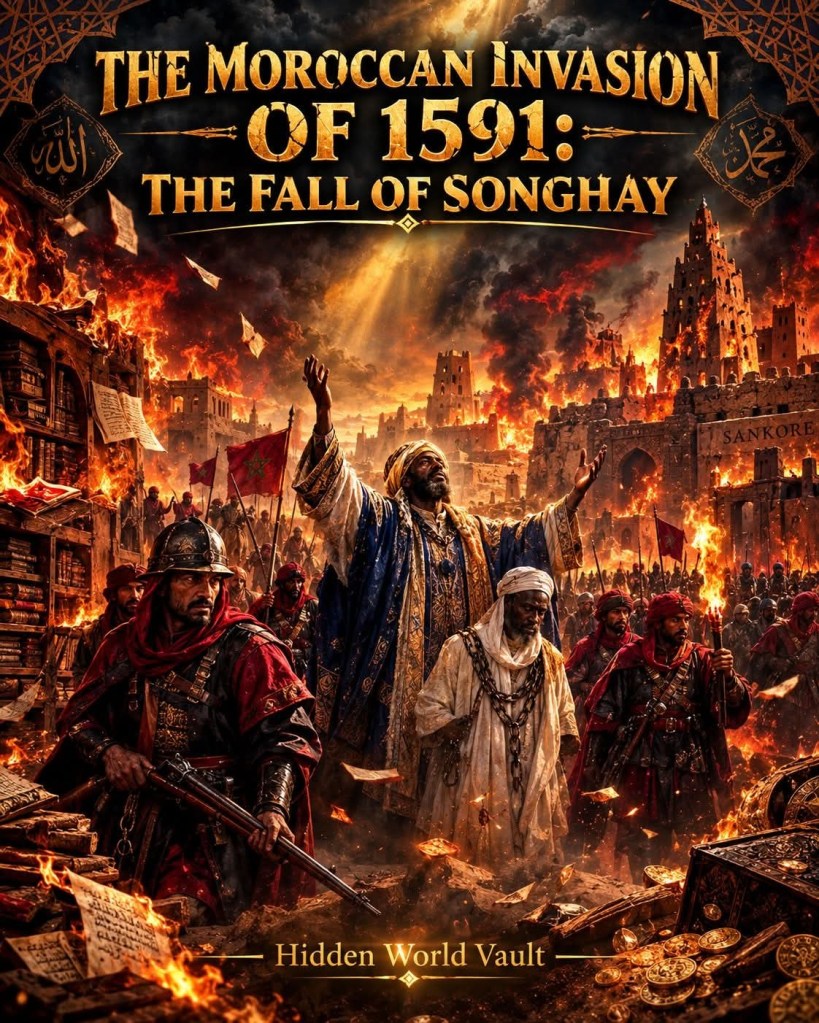
The Moroccan army was equipped with firearms, a technology the Songhay had never seen. The Tarikh ‘s-Sudan describes the invasion as a catastrophe. The Moroccans sacked Timbuktu, killed many scholars, and took others as captives to Marrakech.
The author of the Tarikh writes:
“Then the news reached him that the Mossi-Koy and his army were determined to make war against him… In this way Allah ta`ala protected the people of Walata from the evils of Sonni Ali.”
— Tarikh ‘s-Sudan, Chapter XII
But this time, there was no protection. The Moroccans looted the libraries, destroyed mosques, and killed or enslaved thousands. The great centers of learning, Sankore’, Jingerber, Sidi Yahya, were desecrated. The scholars who had built Timbuktu’s reputation were scattered, imprisoned, or killed.
The Tarikh records that the Moroccan invasion was the third destruction of Timbuktu:
“Tinbuktu was destroyed three times: the first time was by the hand of the ruler of Mossi; the second time was at the hands of Sonni Ali; and the third time was at the hands of the pasha Mahmoud ibn Zarqun which was weaker than the first two.”
— Tarikh ‘s-Sudan, Chapter III (quoting Ahmad Baba)
■ AHMAD BABA – THE CAPTIVE SCHOLAR
Ahmad Baba (d. 1626) was among those taken captive to Marrakech. He was the most celebrated scholar of Timbuktu, the author of over 40 works on jurisprudence, theology, grammar, and history. His most renowned work, the Nayl ‘l-Ibtihaaj, is a biography of the scholars of the Maliki school.
The Tarikh ‘s-Sudan describes him as:
“The jurist, the learned scholar, the unique of his age, the matchless one of his time, proficient in every variety of sciences… He was earnest and strenuous from the beginning of his affair in the service of knowledge until he outstripped all of his contemporaries and surpassed them exceedingly.”
— Tarikh ‘s-Sudan, Chapter IX
Ahmad Baba spent years in Marrakech but continued to write and teach. His works are a testament to the resilience of the scholars of Timbuktu. He was eventually allowed to return to Timbuktu, where he continued to teach until his death.
■ THE DESTRUCTION OF LIBRARIES AND MANUSCRIPTS
The Moroccan invasion was not just a military conquest; it was a cultural catastrophe. The Tarikh ‘s-Sudan records that the Moroccans looted the libraries of Timbuktu, destroying or taking away thousands of manuscripts. The great collections of Sankore’ University, which included works on jurisprudence, astronomy, medicine, mathematics, and history, were scattered.
The author of the Tarikh notes that the Moroccan pasha Mahmoud ibn Zarqun was responsible for much of the destruction:
“It was said that in the destruction caused by Sonni Ali there was much slaughter and killing, much more even than the destruction caused by the ruler of Mossi.”
— Tarikh ‘s-Sudan, Chapter III (quoting Ahmad Baba)
But the Moroccan destruction was different—it was systematic. The Moroccans understood that the scholars were the backbone of Songhay civilization. By destroying the libraries and killing or exiling the scholars, they crippled the intellectual life of the region.
THE AFTERMATH – DECLINE AND DEVASTATION
The Moroccan invasion marked the beginning of the decline of Islamic scholarship in the region. It also paved the way for the transatlantic slave trade, which would devastate West Africa for centuries.
The Tarikh ‘s-Sudan records that after the invasion, the scholars of Timbuktu were scattered. Some were killed, some were imprisoned, and some fled to other regions. The great centers of learning fell into ruin. The Tarikh itself was written in the aftermath of this catastrophe, as a witness to what had been lost.
The author, al-Qadi Abd’r-Rahman as-Sa’di, wrote:
“When I perceived that this science and its study had become extinct and its wealth and the tremendous advantages it brings from comprehending human nature, their homelands, forefathers, social classes, chronicles and the causes of their decline; had weakened – I sought Allah’s assistance… in writing what I had memorized.”
— Tarikh ‘s-Sudan, Introduction
He wrote the Tarikh to preserve the memory of what had been destroyed. It is a testament to the resilience of the scholars and the importance of history.
■ THE LEGACY OF THE INVASION
The Tarikh ‘s-Sudan stands as a witness to this tragedy. It is a reminder that African civilizations were not primitive, they were sophisticated, wealthy, and learned. And their destruction was a loss for all of humanity.
The Moroccan invasion of 1591 was not just the fall of an empire, it was the destruction of a civilization. The scholars of Timbuktu had built a society based on knowledge, justice, and faith. The Moroccans destroyed that society with fire and sword.
But the legacy of Timbuktu lives on. The manuscripts that survived are being preserved and studied. The names of the scholars: Ahmad Baba, Qadi Mahmud, Shaykh Abd’r-Rahman, are remembered. The Tarikh ‘s-Sudan itself is a testament to the resilience of a people who refused to be forgotten.
REFERENCES :
as-Sa’di, al-Qadi Abd’r-Rahman. Tarikh ‘s-Sudan: The History of the Land of the Blacks. Translated by Abu Alfa Umar Muhammad Shareef bin Farid. Maiurno, Sennar, Sudan: SANKORE’ Institute of Islamic – African Studies, 1410/1990.
· Introduction: The author’s purpose in writing the Tarikh
· Chapter III: The Reign of the Sultan of Mali, Kankan Musa, of Songhay (quoting Ahmad Baba on the three destructions of Timbuktu)
· Chapter IX: Biography of the Scholars, the Righteous and Judges of Tinbuktu (Shaykh Abd’r-Rahman’s prophecy and Ahmad Baba’s biography)
· Chapter XII: Mentioning the Infamous Tyrant Sonni Ali (the Moroccan invasion and its aftermath)
ADDITIONAL SOURCES REFERENCED IN THE TEXT :
· Ahmad Baba, Nayl ‘l-Ibtihaaj Bi Tatreez ‘d-Dibaaj (quoted in the Tarikh ‘s-Sudan)
· Ibn Batuta, Ar-Rihla (quoted in the Tarikh ‘s-Sudan)
How can we preserve the legacy of Timbuktu and Songhay today? Share your ideas! 👇
 Hi welcome to my website