
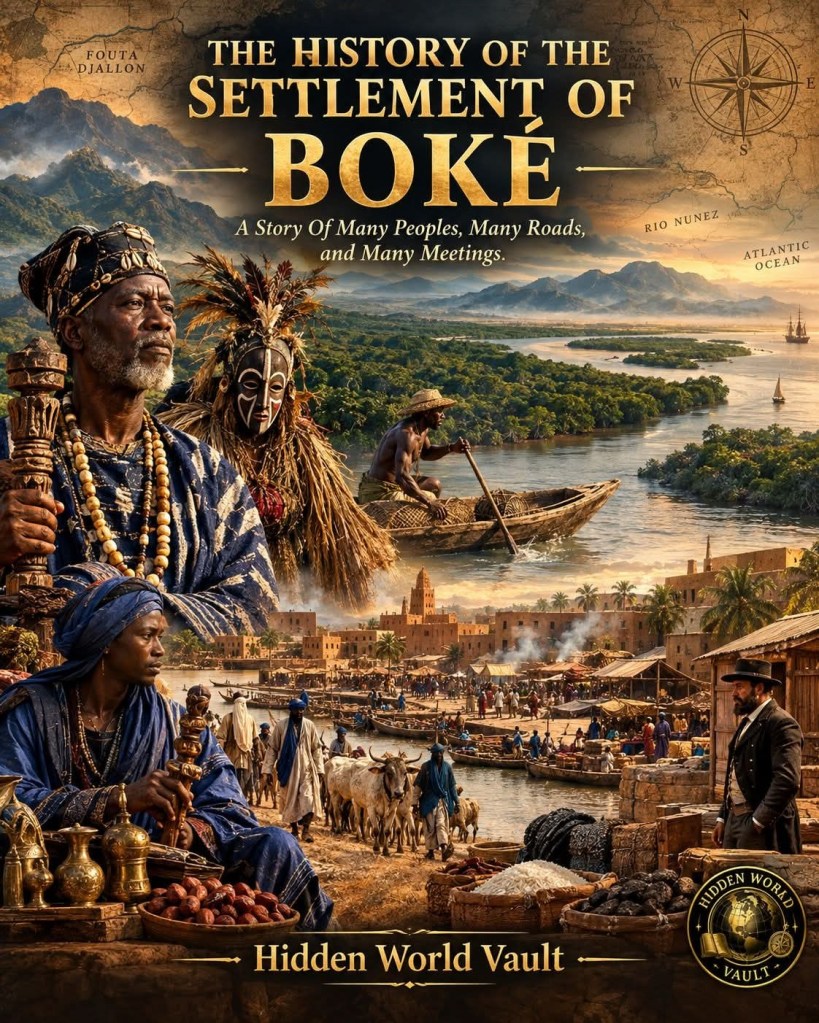
THE HISTORY OF THE SETTLEMENT OF BOKÉ: A Story of Many Peoples, Many Roads, and Many Meetings.
THE HISTORY OF THE SETTLEMENT OF BOKÉ: A Story of Many Peoples, Many Roads, and Many Meetings.
Introduction: Boké, an ancient space of encounters
The region of Boké, which largely matches the old Kakandé and the Rio Nunez basin, holds a special place in the history of Guinea. It sits between the Atlantic coast, Fouta Djallon, the region of Gaoual, and Guinea Bissau. For many centuries, it has been a zone of movement for people, goods, and cultural influences.
It is important not to present the settlement of Boké as the arrival of one single people at one exact date. The available sources show something much richer. They show a long succession of settlements, migrations, displacements, intermixing, and integration. Different groups came, stayed, moved, mixed, and built new communities together.
The populations historically linked to this space include the Landouma, the Baga, and the Nalou. Over time, Manding, Fulani, Sousou, Diakanké, and other groups joined them. Ancient sources describe the country of the Rio Nunez as an ethnically diverse space. This diversity is not a recent accident. It is one of the oldest features of the region.
- The ancient populations: Baga and Nalou on the coastal side
The Baga and the Nalou are among the most anciently attested populations on the coast between the region of Conakry and the border of Guinea Bissau. A study devoted to the populations of Guinea indicates that the Baga and their related populations, especially the Nalou, are considered the first historically recognized inhabitants of this part of the maritime façade.
The Baga occupied coastal zones and the valleys of different watercourses. Several Baga groups appear in historical sources. Among them are the Baga Sitemu, the Baga Mandouri, and the Baga Foré. Each group had its own local life, but they shared a broad coastal world.
The Nalou were particularly present in the lower part of the Rio Nunez and in neighboring regions. Their presence helped shape the riverine and coastal character of the area. This old implantation explains why the region of Boké cannot be historically reduced to Landouma settlement alone. Kakandé was a space of contact between interior populations and coastal populations.
- The installation of the Landouma in Kakandé
The history of Boké is inseparable from the history of the Landouma. They occupied mainly the middle and upper part of the Rio Nunez. Their story is one of movement, memory, and adaptation.
The historical sources collected by the colonial administrator A. Demougeot report a Landouma tradition. According to this tradition, the Landouma belong to the great family of the Tiapys. Their ancestors are said to have come from the region of Mandé, near Siguiri. Before reaching Kakandé, they stayed in Fouta Djallon. Then, following the expansion of Muslim Fulani populations in Fouta Djallon, part of the Tiapys moved toward the west and northwest. One fraction finally reached Kakandé.
It is important to stress that this is a tradition of origin reported by the sources. It is not a fact that can be dated with precision using documents written at the time of the migration. Oral tradition is precious, but it works in a different way from a modern dated archive. It preserves memory, identity, and lineage. It should be listened to carefully and compared with other sources.
- Kakandé: the historical territory of the Landouma
One essential point must be made clear. Kakandé did not originally designate only a city. Demougeot explains that at the end of the eighteenth century, European maps already mentioned Kakandé. But for local populations, Kakandé meant above all a region inhabited by the Landouma. It was not simply a village.
This precision is fundamental for understanding the history of Boké. The territory was organized around several villages and establishments. Among these was Wakrya, considered an ancient political center of the Landouma.
The traditions collected by Demougeot indicate that the first Landouma chiefs of Kakandé belonged to two lineages. These lineages were associated with the ancestors Mandialé Coumbassa and Modiéré. Power was exercised alternately by the descendants of these two lineages. This explains why the royal residence could be found sometimes at Kakandé and Wakrya, sometimes at Boké. Political power moved between places, and this movement shaped the region.
- The birth of the site of Boké
The current city of Boké seems to have originated from an establishment linked to the Landouma settlement. Demougeot reports that a few kilometers upstream from Kakandé there was an ancient cultivation hamlet. It was founded by a family detached from the main group. This establishment carried several names in European accounts and documents before the form Boké imposed itself.
It was therefore a gradual process. The site of Boké did not become important in one day. At the beginning of the nineteenth century, it was not yet the great administrative city that we know today. It was essentially an establishment situated in a Landouma space. Little by little, commerce transformed it.
- The arrival of European traders and the opening of Kakandé
The real change came with the intensification of European commerce on the Rio Nunez. From the end of the eighteenth century, European maps show the existence of several establishments along the river. At the beginning of the nineteenth century, European traders were installed in Kakandé, notably at Boké and Wakrya.
The geographical position of Boké was exceptional. It was close to the Rio Nunez. It had access to commercial routes toward Fouta Djallon. It was near the Atlantic coast. It could receive caravans coming from the interior. These advantages made Boké a natural meeting point.
Boké would therefore progressively become an interface between coastal populations and the populations of Fouta Djallon. It was not only a place where goods were exchanged. It was also a place where languages, customs, and loyalties met and mixed.
- The passage of René Caillié
This commercial importance also explains why René Caillié departed from the region of Kakandé in 1827 to undertake his famous voyage toward Timbuktu. He left Kakondy, near Boké, on April 19, 1827. He took routes crossing Fouta Djallon before continuing toward Upper Guinea and Timbuktu.
His passage is an important testimony. It shows that from that time there was already a commercial network linking the coast of the Rio Nunez to the regions of the interior. The routes were not empty. They carried traders, travelers, news, and goods. Boké and its surrounding area were part of a wider world.
- The progressive arrival of Fulani and Manding populations
The commercial development of Boké also favored the arrival and installation of populations from Fouta Djallon and the Manding world. Historical sources describe the Landouma as being in close relation with the Fulani populations of Fouta Djallon. The commerce of the Rio Nunez attracted caravans coming from the interior.
The Fulani, the Diakanké, the Manding and Sarakolé, and other Muslim populations thus progressively participated in the demographic and cultural transformation of Kakandé. This was not a brutal replacement of ancient populations. It was rather a process of installation and intermixing around commercial centers. People came for trade, for work, for marriage, for safety, or for new opportunities. Over time, they became part of the local society.
- Boké in the mid nineteenth century: an already complex society
On the eve of effective French colonization, the Rio Nunez already presented an important diversity. French sources of the nineteenth century distinguish several groups. The Landouma lived in the upper part of the Rio Nunez. The Nalou lived in the middle and lower part. The Baga lived in the coastal zones. The Fulani and other Muslim populations came from Fouta Djallon. European traders were installed in the principal centers.
This diversity explains the sometimes complex relations between different groups. The sources of the nineteenth century report conflicts between Landouma and Nalou. There were also alliances, exchanges, and daily interactions. Diversity did not mean permanent harmony, but it did mean constant contact.
- The role of Islam in the transformation of the settlement
Islam progressively penetrated Kakandé through relations with Fouta Djallon and through commercial networks. The Landouma notably experienced a progressive Islamization. At the same time, certain related Tiapy communities preserved more of their traditional religious practices.
The installation of Muslim populations from Fouta Djallon and the development of commerce contributed to profoundly modifying the social and cultural structures of the country. Religion, trade, marriage, education, and law all became part of the slow transformation of the region. This transformation was not uniform. It moved at different speeds in different villages and families.
- The French conquest and the political upheaval
The French arrival constitutes a new major stage. In 1848, France obtained the cession of the site of Boké. Tensions with the Landouma power would however rapidly worsen. In 1849, after the refusal of the Landouma king to conform to French demands, especially concerning the slave trade, the French bombarded Boké and took control of the site.
But this first occupation did not yet mean that the entire region was directly administered by France. A new stage occurred in 1866. On January 19, 1866, French troops effectively occupied the plateau of Boké. Three days later, a treaty concluded with the Landouma king Douka placed the Landouma country under French suzerainty and protectorate. This was a turning point in the political history of the region.
- Boké progressively becomes an administrative and commercial center
The French presence brought about a profound transformation of the city. Boké progressively became the administrative and commercial center of the Rio Nunez. At the end of the nineteenth century, commerce concentrated there more and more. This happened notably because caravans coming from Fouta Djallon converged there.
Demougeot explains that around 1890, the rubber trade contributed strongly to the prosperity of Boké. Commercial houses progressively abandoned certain establishments situated lower on the river to concentrate in the city. Boké then changed its appearance. Laid out roads, shops, administrative infrastructures, and European presence contributed to the emergence of a true colonial city. The old Landouma establishment was now part of a wider colonial order.
- Migrations and intermixing in the colonial era
The colonial period further accelerated population movements. Boké attracted many different people. There were European traders. There were populations from Fouta Djallon. There were Muslim traders. There were Sousou populations. There were Manding and Diakanké. There were workers and civil servants from other regions.
Sources from the beginning of the twentieth century already testify to this diversification. A colonial notice describes the circle of Boké as grouping the Landouma, Nalou, Foulacoundas, Tenda, Yola, Mikiforé, and Baga Foré, among other populations. This list shows that Boké had become a meeting place for many different communities.
- Boké today: the outcome of a long intermixing
The current population of Boké is therefore the result of several centuries of movements. One finds there notably Landouma, Baga, Nalou, Sousou, Fulani, Diakanké, Mikiforé, and Manding. To these were added over time other populations who came to work, trade, or settle in the region. The modern city has thus become one of the most cosmopolitan cities of Guinea.
This cosmopolitan character is not a break from the past. It is a continuation of the old role of Boké as a meeting point. The city has always been a place where different worlds touched. The coast met the interior. The river met the caravan routes. The Landouma world met the Fulani and Manding worlds. Local traditions met Islam and European commerce. Today, that long history lives in the streets, families, languages, and daily life of Boké.
- Why this history matters
This history matters because it teaches a simple lesson. Communities are not fixed forever. They are built over time. They change through trade, marriage, migration, faith, conflict, and cooperation. Boké is a good example of this. Its identity is not based on one single origin. It is based on many origins that came together.
Understanding this history can help people respect diversity. It can help them see that mixing is not a weakness. It is often a strength. It can also help historians, students, and local communities ask better questions about the past. The story of Boké is not finished. It continues today.
■ A note on sources and method
For a true historical monograph of Boké, it would be useful to confront colonial accounts with Landouma, Baga, and Nalou oral traditions. It would also be useful to study the administrative archives of Boké and Conakry and the works of Guinean university researchers. Colonial sources are precious, but they must be read with a critical mind. Demougeot himself indicates that certain pieces of information on lineages and origins came from traditions collected from local notables. That means the sources themselves are a mixture of observation, archive, and oral memory. They should be handled with care and respect.
REFERENCES
A. Demougeot, “Histoire du Nunez,” Bulletin du Comité d’Études Historiques et Scientifiques de l’AOF, volume XXI, number 2, April to June 1938, pages 177 to 289. The author indicates having used the archives of the Government General of the AOF, the archives of Boké and Conakry, and the monograph of the circle of Boké of 1912.
Thierno Diallo, works on Dinah Salifou, king of the Nalous, notably the developments devoted to the Baga, Nalou, and Landouma.
Henri Hanotaux and Alfred Martineau, La formation de la colonie de la Guinée française, 1875 to 1904, for the period of conquest and French occupation.
René Caillié, voyage account of 1827, an important testimony on the routes linking Kakandé to Fouta Djallon.
Notice sur la Guinée française, colonial documentation describing the populations and the organization of the circle of Rio Nunez and Boké at the beginning of the twentieth century.
Ethnographic studies on the populations of Lower Guinea, notably the works of Maurice Houis on the linguistic relations between Sousou, Baga, and Nalou.
 Hi welcome to my website