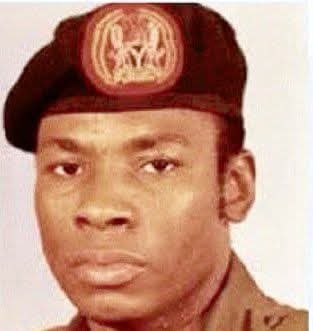
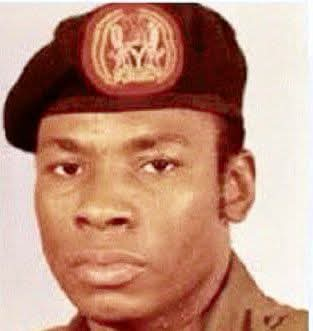
TUNDE IDIAGBON: THE POWERFUL GENERAL WHO LO`ST HIS POSITION IN A CO’UP — AND D1€D UNDER CIRCUMSTANCES THAT RAISED QUESTIONS
TUNDE IDIAGBON: THE POWERFUL GENERAL WHO LO`ST HIS POSITION IN A CO’UP — AND D1€D UNDER CIRCUMSTANCES THAT RAISED QUESTIONS
He was one of the most powerful men in Nigeria.
He helped lead a milit@ry government that promised to fight corruption and restore discipline. He became known for his strict approach to leadership, and many Nigerians remembered him as a man who tolerated little disorder.
But in August 1985, the govern`ment he served was overthrown in a milit@ry co’up.
He was det@ined for years.
After his rele@se, he returned to private life in Ilorin, Kwara State, far away from the power he once exercised.
Then, on March 24, 1999, Major-General Babatunde Abdulbaki Tunde Idiagbon d1ed.
He was 55 years old.
And his de@th raised questions that have never been conclusively answered in the public accounts I could verify.
THE MAN WHO STOOD BESIDE BUHARI
Born on September 14, 1943, in Ilorin, Tunde Idiagbon joined the Nigerian Army and rose through its ranks.
He served during the Nigerian Civil W@r and held several important milit@ry positions. He also served as milit@ry governor of Borno State between 1978 and 1979.
However, his name became nationally prominent after the military co’up of December 31, 1983, which brought Major-General Muhammadu Buhari to power.
Idiagbon became Chief of Staff, Supreme Headquarters, effectively the second-in-command of the milit@ry government.
Together, Buhari and Idiagbon launched the W@r Against Indiscipline, a campaign intended to promote order, discipline and national responsibility.
Nigerians saw campaigns against queue-jumping, lateness and other forms of public disorder. The government also pursued an aggressive anti-corrupt;!on agenda.
But the administration was controversial. Its use of det€ntion without tri@l and restrictions on civil liberties drew criticism.
Idiagbon became one of the most recognisable faces of the government.
THEN CO’UP OF 1985 CAME
On August 27, 1985, General Ibrahim Babangida overthrew Buhari’s government while Idiagbon was outside Nigeria.
The man who had helped wield enormous power was suddenly r€moved from office.
Upon his return, Idiagbon was detained. He remained in political detention for about 40 months before being released in December 1988.
He subsequently returned to Ilorin and largely stayed away from public office.
For a man who had occupied such a powerful position, it was a dramatic change in circumstances.
MARCH 24, 1999: THE GENERAL D1€S
Idiagbon di€d at his home in Ilorin on March 24, 1999.
News of his de@th prompted questions about what had happened to the former milit@ry strongman.
A contemporary report published by The News on March 29, 1999, described the questions being asked by residents of Ilorin. Some speculated about po!soning, but the report made clear that these suspicions had no proof.
The report also stated that no @utopsy had been performed to establish the cause of de@th.
That distinction matters.
Rumours about poisoning circulated, but rumours alone cannot establish that someone was murdered.
Years later, Idiagbon’s son also dismissed po1soning allegations as speculation in an interview with Punch.
WAS HE POI$1ON€D?
This remains the question that attracts attention whenever Idiagbon’s de@th is discussed.
However, the available accounts I examined do not establish that he was poisoned, nor do they demonstrate that anyone deliberately caused his death
His son said he had been sick before he died.
What can be said is that Idiagbon’s sudden death prompted questions, and those questions became part of the story surrounding his final days.
A POWERFUL MAN, A QUIET END
Tunde Idiagbon di€d in the same year Nigeria returned to civilian democratic rule.
He had once been one of the country’s most influential military figures. Yet, after losing power and spending years in det€ntion, he spent his final years largely outside public life.
His legacy remains complicated. Some Nigerians remember his reputation for discipline and his anti-corruption campaign. Others remember the authoritarian methods employed by the government he helped lead.
But his de@th remains a subject of public curiosity because the circumstances were not fully clarified in the contemporary accounts available to the public.
Major-General Tunde Idiagbon died on March 24, 1999, aged 55.
More than two decades later, one thing is important to remember: questions about a de@th are not proof of mur’der.